How to Price Services for a Small Business in the UK
A service price should do more than beat a competitor’s quote. It needs to cover your real costs, reflect the value you provide and leave enough margin to run the business properly. Here is a practical way to build prices that make sense and are easier to explain to customers.
By George Adams · Published 18 October 2026 · Updated 18 October 2026 · 13 min read
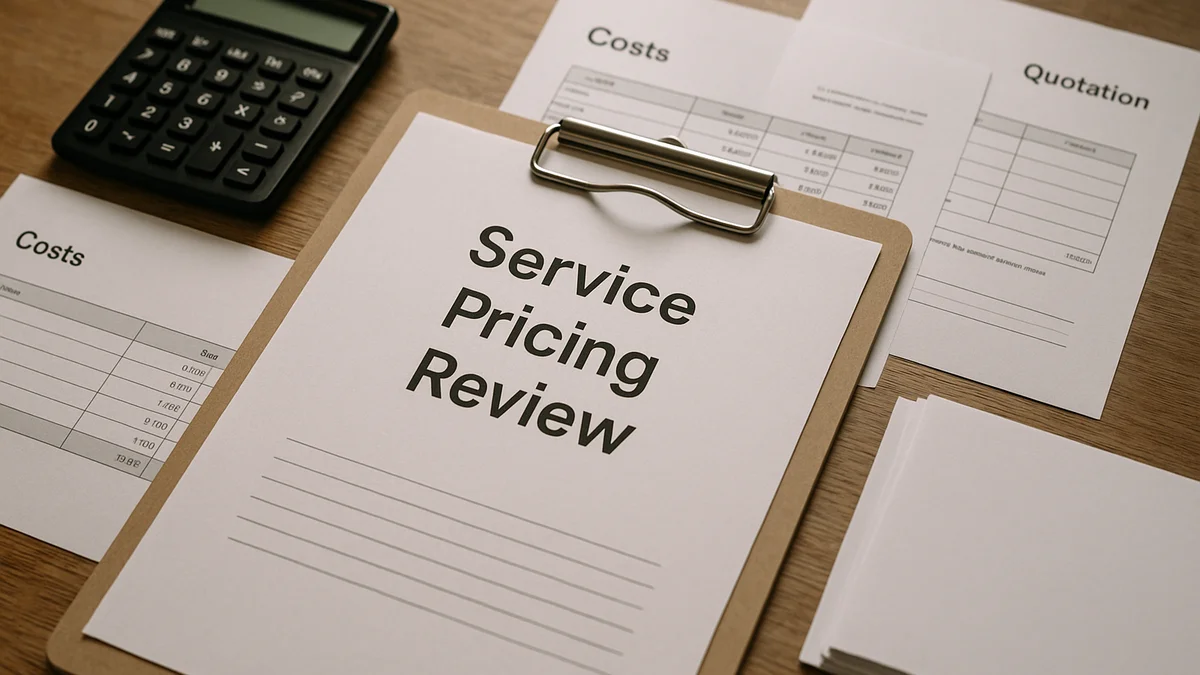
Many small business owners underprice services for the same reason: the number feels easier to sell. They copy a competitor, round down to something tidy, or pick an hourly rate that sounds acceptable without checking whether it actually covers the business. That can keep enquiries coming in, but it often leaves you busy, underpaid and unsure why profit never improves.
Pricing services needs a clearer process than guessing. Start with your minimum profitable number, then decide how you want to charge, and finally check whether the offer is specific enough for the price to hold. The right figure is not always the lowest one in the market. It is the one that covers your real costs, fits the way you deliver the work and makes sense to the customer.
For UK small business owners, sole traders and early-stage service firms, this is partly a maths exercise and partly a commercial one. You need to know what the job costs you, but you also need to think about scope, demand, customer type and the outcome the client is buying.
Why pricing services is harder than pricing products
With a product, you can often count units, stock and direct costs. With a service, the thing you sell is less visible. You are selling time, skill, judgment, availability and often unfinished work. That means two jobs with the same headline price can produce very different profit outcomes depending on how much input they take, how efficient you are and how well the scope was defined.
A service can also expand without warning. A client may want extra revisions, urgent turnaround, site visits, meetings or more hand-holding than you expected. If your pricing model does not account for that, your margin disappears even when the quote was accepted happily.
This is why service pricing should begin with the business model, not with a competitor’s brochure or a number that feels neat. The price has to work for your delivery process, your capacity and your cash flow as well as for the customer.
Start with your real cost base
The first useful question is not “what do others charge?” but “what does it cost me to stay in business and take home the income I need?” If you do not know that figure, every price is a guess.
Start by listing the costs that sit behind your service, including:
- business overheads such as rent, phone, internet and office costs
- software, subscriptions and tools you need to deliver the work
- insurance and professional fees where relevant
- travel, parking and other delivery costs
- admin time, quoting time and bookkeeping time
- unpaid time spent on marketing, chasing invoices and answering enquiries
- the amount you need to pay yourself before tax
If you are a sole trader or considering a different structure, the legal and tax position matters too. GOV.UK explains that most businesses register as a sole trader or limited company, and that the structure you choose can affect how you pay tax and your legal responsibilities. It also notes that sole traders keep the profits after paying tax, while limited companies are separate legal entities with different responsibilities for directors and owners. See GOV.UK — Set up a business and GOV.UK — Set up a limited company.
That does not mean pricing should be turned into an accounting project. It means the business owner needs a clear floor price: the minimum amount that makes a job worth doing.
Turn your cost base into a floor price
A floor price is the lowest price you can charge without losing money over time. It should include more than just direct delivery costs. If you only count the hours spent on the visible part of the job, you will underprice because you have ignored the hidden time around it.
A simple way to build the number is to:
- work out your annual business costs
- add the income you need to draw from the business
- estimate the number of billable hours or billable projects you can realistically sell
- divide the total required income by that capacity
The result is not your final price, but it is the minimum you should respect when setting it. If a quote sits below that figure, you are either subsidising the work from somewhere else or accepting lower profit than you intended.
Choose the pricing model that fits the service
There is no single best pricing model for every service business. The right choice depends on how predictable the work is, how much scope changes, how customers buy, and how easily they can compare you with other suppliers.
Hourly rates
Hourly billing is the simplest model to understand. The customer pays for the time you spend, which makes it useful when the scope is uncertain or work varies a lot from client to client. It is common for advisory work, technical support and some one-off services.
The risk is that hourly billing rewards slow delivery. If you become more efficient, your earnings may not rise in proportion unless you review the rate. It can also make customers focus on the clock rather than the outcome. That is not always a problem, but it can create resistance if clients think they are paying for effort rather than value.
Hourly pricing works best when the work is open-ended or the client needs flexibility, but you should still estimate the likely total and explain what might increase it.
Fixed project fees
Fixed fees are useful when the service has a clear start, middle and end. They are common for design, build, installation, project-based consultancy and many B2B services where the scope can be described in advance.
The advantage is certainty. The customer knows the price, and you can improve your margin by working efficiently. The risk is scope creep: the job grows after the price is agreed, but the fee does not. If you choose fixed pricing, the quote must define exactly what is included and what counts as extra work.
Fixed fees suit businesses that can estimate work accurately and control delivery. They are less forgiving when you are still learning how long jobs really take.
Retainers
A retainer is a recurring fee for ongoing availability or a defined amount of continuing work. It can suit marketing, bookkeeping, account management, maintenance, advisory support and other services where the client wants steady access rather than a one-off project.
The benefit is steadier income. It can make planning easier and reduce the time spent quoting every small task separately. The downside is that the scope can drift unless you define the monthly output clearly. A retainer that becomes “whatever the client asks for” quickly turns into an underpriced catch-all.
Retainers work best when you can describe what the client gets each month, how requests are handled and what happens if they need more than the allowance.
Packages and tiered offers
Packages are often easier to sell than a blank hourly rate because they help the customer compare options. A simple, standard and premium package can work well if the differences are real and easy to understand.
This approach helps when customers are unsure what they need. It can also improve average order value by showing the next level of service without hard selling. The risk is overcomplicating the menu. If you create too many variations, you make the buying decision harder rather than easier.
For a small business, a package should be a straightforward promise with a clear scope and a sensible margin.
Work out your capacity, not just your desired rate
One of the most common pricing mistakes is to divide business costs by a number of hours you would like to bill, rather than the number you can realistically sell. In practice, not every working hour is chargeable.
You need time for quoting, admin, marketing, customer service, training, holidays, illness and the parts of the job nobody pays for directly. If you ignore those hours, your rate may look reasonable on paper but fall short in real life.
For example, a consultant may spend a large part of the week on planning, meetings, proposal writing and follow-up. A designer may spend time on revisions, admin and file management. A trades-based service may face travel time, site surveys, waiting around and materials coordination. All of those affect the number of billable hours available.
The practical point is simple: price against usable capacity, not against total working hours. If you want to know whether a rate is viable, ask how many hours or projects you can sell after everything else has been removed.
Check the market without letting it set your price blindly
It is sensible to know what competitors charge, but dangerous to let that number decide your price on its own. Two businesses can appear similar and still be very different in quality, speed, specialist knowledge, guarantees, location or customer type.
A higher price may be justified if you deliver faster turnaround, deeper experience, better support or lower risk for the customer. A lower price may be necessary if you are new, under-capacity or targeting a more price-sensitive segment. The point is not to charge more just because you can. The point is to understand why the market accepts one figure and rejects another.
When comparing competitors, look at the offer in full rather than the headline price alone. Ask yourself:
- What exactly is included?
- How much support does the customer get?
- Is the business specialised or generalist?
- Is the service local, remote or national?
- Does the provider seem to sell speed, reassurance, expertise or convenience?
If you work in a segment where the customer values certainty, speed or specialist knowledge, your price may be able to sit above the “average” market rate. If your market is highly price-sensitive, you may need a tighter offer and sharper efficiency to protect margin.
Price for scope, not just deliverables
A quote is easiest to defend when the customer understands exactly what they are buying. The more clearly you define scope, the less chance there is of a disagreement later.
This means spelling out:
- what is included in the price
- what is excluded
- how many revisions or changes are allowed
- response times and working hours
- whether travel, materials or third-party costs are extra
- what counts as additional work
Good scope control is not about being awkward. It is about preventing the price from being eroded by assumptions. If the customer thinks three rounds of revisions are included and you assumed one, the job will feel expensive to them and underpaid to you.
Clear scope also makes it easier to explain why a higher price is reasonable. The customer is not just buying a deliverable. They are buying certainty, boundaries and a defined result.
Illustrative example: a freelance designer
A freelance designer may be tempted to quote by the hour because design work can be hard to predict. But if most of the project follows a similar pattern, a fixed fee with a defined scope may be better for both sides. The designer can include a set number of concepts, a fixed number of revisions and clear rules for extra changes.
That makes the price easier to sell than a vague hourly estimate. It also protects the designer from endless tweaks that would otherwise reduce the effective hourly rate.
Illustrative example: a consultant
A consultant often sells judgment as much as time. In that case, the hourly rate may understate the value of a short piece of advice that prevents a costly mistake. A fixed advisory package or retainer can work better because the client is paying for access to expertise rather than a stopwatch.
The consultant still needs a floor price, but the commercial conversation should also focus on the risk avoided, the decision improved or the time saved for the client.
Illustrative example: a local service business
A local service business such as a cleaner, maintenance provider or installation firm may need a different structure again. Travel time, repeat visits, call-outs and regional demand all affect pricing. A price that looks fine on the job sheet can become weak if the operator has to drive too far, wait too long or return more often than expected.
In this kind of business, packages, minimum charges or clear service zones can protect margin better than a simple hourly figure.
Use value-based thinking where it is justified
Cost-based pricing tells you the minimum. Market pricing tells you what similar services seem to fetch. Value-based pricing asks what the work is worth to the customer.
This matters when your service helps a client save time, reduce risk, improve revenue or avoid a costly mistake. If your work produces a clear commercial outcome, the price does not have to be tied closely to the hours you spend. A brief engagement can be valuable if it solves a large problem.
That does not mean you should invent a bigger benefit than exists. It means you should look at the customer’s outcome, not just your input. A service that saves a client many hours, prevents errors or supports a revenue-generating decision may justify a higher fee than a simple time-cost calculation would suggest.
The practical challenge is to explain that value without sounding inflated. Customers are more likely to accept a higher price when you can connect it to a specific result, a reduced risk or a practical business benefit.
Use a simple quoting and review process
Pricing is not something you do once and forget. Costs rise, delivery gets faster or slower, customer expectations change and some offers become more popular than others. You need a simple way to review whether your prices still work.
A useful process is to keep a standard quote template that includes the scope, the price, the assumptions and the limits of the offer. That saves time and makes your pricing more consistent. It also helps new enquiries see the structure of the offer quickly.
Keep a record of why jobs were won or lost. If customers keep saying a quote is too high, the answer may be the price, but it may also be the offer, the wording or the scope. If you win every job easily, the price may be too low or the segment may be more price-sensitive than you thought.
Review your prices regularly, especially after changes in overheads, software costs, travel costs, staff levels or delivery speed. A small adjustment made on time is easier than a large correction made after months of weak margins.
| Pricing model | Best for | Main advantage | Main risk |
|---|---|---|---|
| Hourly rate | Uncertain or variable work | Simple to explain | Rewards inefficiency |
| Fixed project fee | Clear, defined scopes | Protects efficient delivery | Scope creep |
| Retainer | Ongoing support or access | Stable recurring income | Scope drift |
| Package | Services with obvious tiers | Easier comparison for buyers | Too many options |
A practical decision sequence for small businesses
If you want a simpler way to approach pricing, use this sequence:
- Calculate your minimum profitable price from real costs and owner income.
- Choose the pricing model that suits the service and the customer’s buying habit.
- Check how many billable hours or projects you can realistically sell.
- Compare the market to understand the range, not to copy it.
- Define the scope carefully so the price is not weakened by extras.
- Decide whether the offer supports value-based pricing.
- Review the result after each job or retainer cycle.
If you follow that sequence, price becomes a decision rather than a guess. You may still adjust the number after testing it with real enquiries, but you will know why it is set where it is.
What business structure changes and what it does not
Your pricing method does not change just because you trade as a sole trader or a limited company. What changes is how you extract money, how you record things and how the tax and legal side affects the business. GOV.UK says sole traders can start trading straight away, while limited companies must be registered before trading and have different responsibilities for records and tax. That matters for your finances, but it does not replace the need to price properly.
In other words, a limited company does not magically make a weak price better, and a sole trader does not need to keep prices low just because the structure is simple. The commercial question is the same either way: does the service price cover the cost of delivery, leave room for profit and make sense to the customer?
Before you publish your next quote
The simplest test is also the most useful. Before you send the next proposal or update your price list, make sure you know three things:
- your minimum profitable price
- the exact scope you are selling
- the reason a customer should pay that amount rather than a cheaper one
If you can answer those three questions clearly, your pricing is likely to be much more robust. If you cannot, the problem is usually not the quote format. It is that the business has not yet decided what it is really selling.
Decision checklist: calculate the floor price, choose one main pricing model, define scope in writing, test the price with real enquiries, and review margin after each job or retainer cycle.
Related articles

Why Business Directories Still Matter for UK Businesses
For UK businesses, being easy to find online can make a real difference. A well-maintained business directory listing can improve visibility, help customers verify company information and create another route to a business website. This article looks at why business directories still matter and how they can support local discovery, trust and long-term online presence.
25 October 2026 · 8 min read
How to manage business expenses more effectively
Business expenses become harder to control when spending is spread across cards, bank accounts, subscriptions and ad hoc purchases. A better system starts with clear rules, immediate record-keeping and regular category reviews, so you can see what is allowed, what is drifting and what needs action.
23 October 2026 · 11 min read
What financial reports should a small business owner review monthly?
A monthly review should do more than confirm the bank balance. The right report pack shows whether you are profitable, collecting cash, meeting what you owe and spotting problems early enough to act.
22 October 2026 · 13 min read
How to create a monthly management report for a small business
A monthly management report should help you make decisions, not just file numbers away. This guide shows how to build a short, repeatable report with the figures, commentary and actions that matter for a small business.
21 October 2026 · 11 min read
How to calculate profit margin for a service business
Service businesses can look busy and still fail to earn enough once subcontractors, software, travel, admin time and overheads are counted. This guide shows how to calculate gross and net profit margin properly so you can price work, plan staffing and judge whether growth is actually improving profit.
19 October 2026 · 11 min read
How to create a business continuity plan for a small company
A small company continuity plan should be short, practical and written around the interruptions you are most likely to face. Start with the activities that keep cash coming in, decide who takes charge, set out the first response for each likely disruption and make sure staff can contact the right people if the office, systems or supplier network fail.
17 October 2026 · 13 min read