Why Business Directories Still Matter for UK Businesses
For UK businesses, being easy to find online can make a real difference. A well-maintained business directory listing can improve visibility, help customers verify company information and create another route to a business website. This article looks at why business directories still matter and how they can support local discovery, trust and long-term online presence.
By Emily Walker · Published 25 October 2026 · Updated 25 October 2026 · 8 min read
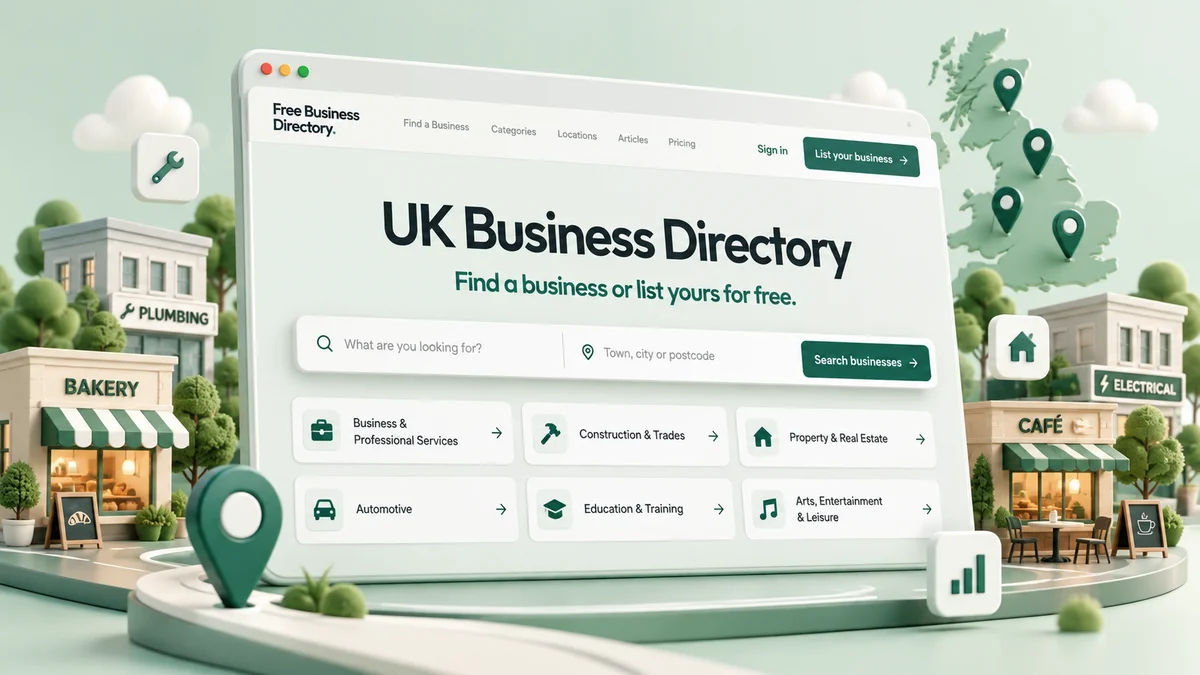
Running a business in the UK has never been particularly simple. Competition is strong, customers compare more options than ever, and even a good company can remain almost invisible online if people do not know where to find it. This is where platforms such as https://freebusinessdirectory.uk/can play a useful role, giving businesses another place to present themselves, be discovered and provide customers with clear information about what they do.
For many small and medium-sized businesses, being found is half the battle. A local electrician, accountant, web designer, restaurant or cleaning company may offer an excellent service, but that does not automatically mean potential customers will discover them.
Most businesses are competing for attention in several places at once. There is Google, social media, maps, review platforms, company websites and, increasingly, AI-powered search tools. A business directory adds another route through which somebody can discover a company.
That may sound simple, but simplicity is often the point.
A Business Directory Is Another Door Into Your Business
Think about the way customers actually search.
Someone looking for a plumber may search for a specific company name. Another person may search for plumbers in Manchester. Someone else might simply browse businesses in a certain category before deciding whom to contact.
A directory can serve all of those people.
A properly structured business listing normally brings together the information a customer wants before taking the next step: the company name, business category, location, contact information, website and a short explanation of its services.
Instead of expecting a potential customer to piece this information together from several sources, a directory can present it in one place.
For the business owner, that creates another digital touchpoint without requiring them to build an entirely new marketing campaign.
Visibility Matters More Than Most Businesses Realise
A common mistake among smaller companies is assuming that having a website means they are automatically visible online.
Unfortunately, it does not work that way.
A website can exist for years without attracting much search traffic. Social media profiles can also become quiet very quickly if they are not updated regularly.
Business directories create additional pages through which a company can potentially be discovered.
This is especially useful for businesses that do not have large marketing budgets.
A small business may not be able to compete with national brands for broad Google searches, but it can still build a wider online presence by appearing in relevant directories, local searches and specialist platforms.
Each legitimate mention of the business contributes to a clearer online footprint.
That does not guarantee rankings, customers or sales. Nothing sensible in digital marketing can make that promise. What it does provide is another opportunity to be seen.
And in business, more relevant opportunities to be discovered are rarely a bad thing.
Directories Can Help Customers Confirm That a Business Exists
Trust has become increasingly important online.
Before contacting an unfamiliar company, many customers perform a quick check. They search for the business name, look at its website, check where it operates and try to understand whether the company appears genuine.
A business profile on an independent directory can form part of that research.
For incorporated UK companies, information such as a company number, status or general business activity can also help customers understand who they are dealing with.
This is particularly important when someone is considering spending a significant amount of money.
Hiring a builder, choosing an accountant or appointing a consultant is very different from buying a £10 product online. Customers often want reassurance before making contact.
No directory can replace proper due diligence, but a clear and consistent business profile can make that first impression stronger.
Consistency Across the Web Is Important
Another overlooked benefit of business directories is information consistency.
Businesses regularly change telephone numbers, websites, opening hours or service areas. Unfortunately, old details often remain scattered across the internet.
Customers then encounter conflicting information.
One website shows one telephone number. Another shows an old address. A social profile has not been updated for three years.
That does not inspire confidence.
Maintaining accurate business listings across reputable platforms helps reduce this problem.
A directory profile should therefore not be treated as something a company creates once and then forgets. It should be reviewed occasionally, particularly after important changes to the business.
Even small details matter.
If a customer clicks a website link and reaches a dead page, there is a good chance they will simply move on to another company.
Business Directories Can Support Local Discovery
For many UK businesses, the most valuable customers are not nationwide. They are local.
Hairdressers, tradespeople, restaurants, garages, tutors, cleaning companies and many professional services rely heavily on customers within a particular town, city or region.
Directories that organise companies by location and category can help users narrow down their options.
Someone browsing businesses in Leeds is usually more valuable to a Leeds-based service company than somebody casually viewing its social media post from another country.
That is why location remains such an important part of online business discovery.
A directory can help create those connections by placing businesses within relevant geographic and industry categories.
Again, this should not be seen as a replacement for Google Business Profile, a company website or other marketing activity. It works best as part of a wider online presence.
Smaller Businesses Can Compete on More Equal Terms
Large companies have obvious advantages online.
They have advertising budgets, marketing teams, established domains and years of brand recognition.
Smaller companies rarely have those resources.
Directories reduce that gap slightly because businesses are generally presented in a structured and comparable format.
A small independent company can appear alongside larger competitors within the same category.
The customer can then decide based on relevance rather than simply recognising the biggest brand.
For a new company, this can be particularly useful.
A recently incorporated business may have little online history. A clear directory listing gives it somewhere to begin establishing that presence while its own website and reputation develop.
A Listing Can Send Referral Traffic
Not every website visitor needs to arrive directly from Google.
Referral traffic remains useful.
If someone discovers a company while browsing a directory and then visits its website, that visitor already has some context. They know roughly what the company does and may already have a reason to make contact.
That can be more valuable than completely untargeted traffic.
The quality of those visitors matters more than simply increasing website traffic figures.
One genuinely interested visitor is worth considerably more to a small business than hundreds of people who have no intention of buying anything.
This is another reason businesses should complete directory profiles properly rather than simply entering a company name and leaving everything else blank.
A useful description, correct category and clear contact information make it much easier for the right person to understand the business.
Business Directories Can Also Support SEO
Business directories are often discussed in relation to SEO, sometimes rather too aggressively.
A directory listing should not be viewed simply as a way of obtaining a backlink.
Search engines have become far more sophisticated than that.
The real value is broader.
Directories can create additional discoverable pages for a business, reinforce important information about the company and provide another path through which users can reach its website.
Relevant links can still be useful, but businesses should avoid treating directories purely as a link-building exercise.
The strongest listings are those that genuinely help users.
If a profile clearly explains what a company does, where it operates and how somebody can contact it, then it has a purpose beyond SEO.
That is the type of listing worth creating.
Business Owners Should Take Control of Their Profiles
Where a directory allows businesses to claim their listing, it is usually worth doing.
An unclaimed profile may contain only basic public information.
Once claimed, the business may be able to add richer information such as a logo, photographs, service descriptions, contact details, opening hours or links to its own website and social channels.
More importantly, claiming a listing gives the business greater control over how it is represented.
The company itself knows its services better than anybody else.
A plumbing company may specialise in boiler installations. An accountant may focus on small limited companies. A restaurant may offer private events or specialist menus.
Basic registration data will never communicate those details effectively.
The business owner can.
Directories Are Becoming More Than Lists of Companies
The traditional business directory was essentially an online version of the Yellow Pages.
That model is changing.
Modern directories can increasingly offer businesses additional tools alongside the listing itself.
These might include articles, analytics, lead generation, enhanced profiles, website services or other business tools.
This makes the relationship more useful for both sides.
Customers get better information, while businesses receive a platform that can help them manage and improve parts of their online presence.
The best directories will probably continue moving in this direction.
Simply maintaining a database of company names is easy. Creating something businesses and customers genuinely use is much harder, but considerably more valuable.
A Directory Should Complement, Not Replace, a Business Website
Businesses should not make the mistake of relying entirely on third-party platforms.
A company website remains one of the few online assets that a business can largely control itself.
Social networks can change their algorithms. Advertising costs can increase. Platforms can alter their rules.
A website gives the business its own permanent home online.
Directories work best alongside that website.
A customer might discover the business through a directory, research it further, visit the company website and then make contact.
That journey is perfectly normal.
The objective is not to force every customer through the same route. It is to give them several legitimate ways to discover and evaluate the business.
The Simple Advantage: Being Easier to Find
There is no magic involved in business directories.
A listing will not transform an unsuccessful company overnight, and it cannot replace good service, competitive pricing or a strong reputation.
Its value is much simpler.
It makes a business easier to find.
For UK companies operating in crowded markets, that additional visibility can matter.
A business that appears consistently across the web looks established, gives customers more information and creates more opportunities for discovery.
That is especially important for smaller firms trying to build their presence without spending heavily on advertising.
The internet has made it possible for almost any company to be visible nationally or locally. It has also created an enormous amount of competition for attention.
In that environment, businesses benefit from making themselves available wherever genuine customers may reasonably look for them.
A reputable business directory is one more place to do exactly that.
Related articles

How to manage business expenses more effectively
Business expenses become harder to control when spending is spread across cards, bank accounts, subscriptions and ad hoc purchases. A better system starts with clear rules, immediate record-keeping and regular category reviews, so you can see what is allowed, what is drifting and what needs action.
23 October 2026 · 11 min read
What financial reports should a small business owner review monthly?
A monthly review should do more than confirm the bank balance. The right report pack shows whether you are profitable, collecting cash, meeting what you owe and spotting problems early enough to act.
22 October 2026 · 13 min read
How to create a monthly management report for a small business
A monthly management report should help you make decisions, not just file numbers away. This guide shows how to build a short, repeatable report with the figures, commentary and actions that matter for a small business.
21 October 2026 · 11 min read
How to calculate profit margin for a service business
Service businesses can look busy and still fail to earn enough once subcontractors, software, travel, admin time and overheads are counted. This guide shows how to calculate gross and net profit margin properly so you can price work, plan staffing and judge whether growth is actually improving profit.
19 October 2026 · 11 min read
How to Price Services for a Small Business in the UK
A service price should do more than beat a competitor’s quote. It needs to cover your real costs, reflect the value you provide and leave enough margin to run the business properly. Here is a practical way to build prices that make sense and are easier to explain to customers.
18 October 2026 · 13 min read
How to create a business continuity plan for a small company
A small company continuity plan should be short, practical and written around the interruptions you are most likely to face. Start with the activities that keep cash coming in, decide who takes charge, set out the first response for each likely disruption and make sure staff can contact the right people if the office, systems or supplier network fail.
17 October 2026 · 13 min read