How to Sell a Business in the UK: A Practical Guide
Selling a business is part valuation exercise, part preparation project and part negotiation. This guide explains the main sale routes, what buyers will examine, how to present the business, and the legal and tax steps to manage before completion.
By Jack Turner · Published 9 October 2026 · Updated 9 October 2026 · 13 min read
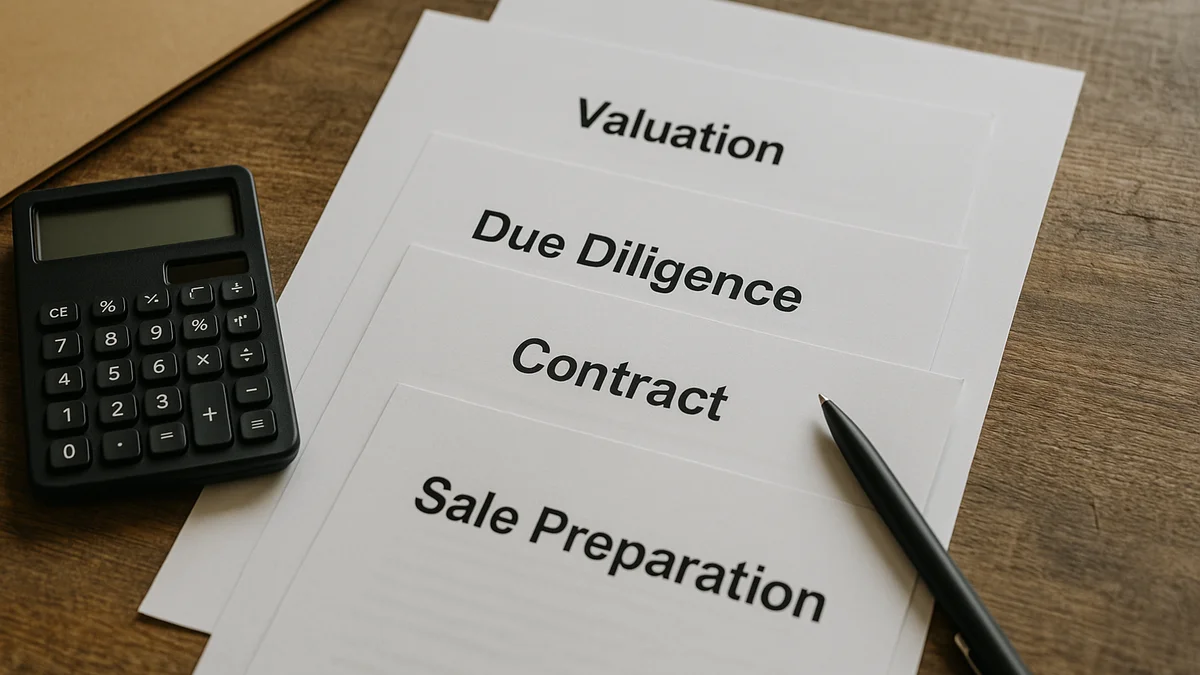
Selling a business is rarely a single decision. It is a sequence of choices: whether now is the right time, whether you want a full exit or a partial sale, which buyer route fits the business, and how much work you need to do before you go to market.
If you get those decisions right early, you improve the chance of a cleaner sale and a better price. If you rush them, buyers tend to spot the weak points quickly: poor records, heavy owner dependence, unclear contracts, or a business that is too reliant on one customer.
This guide sets out the practical steps for UK business owners who want to sell a business sensibly, not simply advertise one and hope for the best.
Key takeaways
- Decide first whether you are aiming for a full exit, a partial sale or a slower handover.
- Value the business on evidence, not optimism: profit, assets, customer mix and market conditions all matter.
- Buyers will test the business through due diligence, so tidy records and fix obvious issues before you start.
- Price is only one part of the deal. Earn-outs, warranties, completion accounts and exclusivity can all affect the final outcome.
- Get legal and tax advice early enough to shape the sale, not merely react to it.
What it means to sell a business and what you need to decide first
To sell a business means transferring some or all of its value, assets, shares or trading activity to another party. In practical terms, that can mean selling shares in a company, selling the business and assets, or selling only part of the ownership and keeping a continuing stake.
Before you do anything else, decide what you are actually selling. That sounds obvious, but it changes almost every other step:
- Share sale: the buyer purchases the company itself, with its contracts, staff and liabilities.
- Asset sale: the buyer purchases selected assets and perhaps takes on some liabilities by agreement.
- Partial sale: you sell some shares or a minority stake and remain involved.
- Full exit: you step away after completion, possibly with a handover period.
The structure matters because buyers often prefer one route over another, and because tax, liabilities and legal documentation differ. If the business is incorporated, the sale may involve company law considerations that do not apply in the same way to an unincorporated trade. GOV.UK notes that most businesses register as a sole trader or limited company, and that the structure affects tax and legal responsibilities.
For a limited company, the legal separation between the company and its owners is also important. GOV.UK states that a limited company is legally separate from the people who own it and that owners have limited liability up to the value of their financial investment. That does not remove sale risk, but it affects what is being sold and what a buyer may expect to review.
When selling makes sense: timing, objectives and whether you want a full exit or partial sale
There is no perfect market moment for every business. A sensible sale usually starts with your own objectives, then asks whether the business is saleable on acceptable terms.
Common reasons owners decide to sell
- You want to retire or reduce day-to-day involvement.
- You want to crystallise value while the business is still strong.
- You need a partner with capital, systems or sector expertise.
- The business has reached a point where growth needs more resources than you want to provide.
- Family succession is not the right answer.
Questions to answer before you engage buyers
- Do you want to leave completely, or stay on for a transition?
- Is your priority the highest headline price, the most certain completion, or the best outcome for staff and customers?
- Are you willing to accept deferred consideration, such as an earn-out, if that improves the deal?
- Could you sell only part of the business now and the rest later?
A full exit can suit owners who want a clean break. A partial sale may suit an owner who wants to keep some upside, reduce risk gradually, or bring in a buyer with operational support. Do not assume that the highest initial offer is the best one if it depends heavily on future performance or subjective assumptions.
The main routes to sale: trade buyer, management buyout, employee ownership, investor sale and asset sale
Different buyers value different things. The best route depends on the shape of your business and what matters to you.
Trade buyer
A trade buyer is another business, usually in the same or a related sector. This route often works well where the buyer can extract synergies: shared overheads, wider distribution, cross-selling or stronger purchasing power.
Trade-off: trade buyers can sometimes pay more if they see strategic value, but they may also be tougher on warranties, integration risk and the price they are prepared to attribute to goodwill.
Management buyout
A management buyout, or MBO, is where the existing management team buys the business. This can work well where the team already understands the operations, customers and culture.
Trade-off: management teams often know the business well, but they may need external funding and may not be able to match a trade buyer’s headline price.
Employee ownership
Employee ownership can suit businesses with strong teams, stable earnings and a founder who wants continuity. It may preserve culture and reduce disruption.
Trade-off: it can be more complex to structure and finance, and it may not suit every business model.
Investor sale
An investor sale means selling to a financial buyer such as a private equity firm, growth investor or other capital provider. These buyers often focus on growth potential, recurring income and scalability.
Trade-off: investors may expect the existing team to stay involved and may seek a further transaction later.
Asset sale
An asset sale means selling equipment, stock, intellectual property, goodwill, contracts or other selected assets rather than the company itself. Buyers may prefer this if they do not want historical liabilities.
Trade-off: asset sales can be simpler for a buyer in some cases, but they may leave value behind if the business depends heavily on contracts, staff relationships or trading history.
How to value your business realistically: profit, assets, customer concentration and market conditions
A realistic valuation is usually a range, not a single number. Buyers will look at multiple factors, and so should you.
Main valuation drivers
- Profit: buyers usually care about sustainable earnings, not just last year’s result.
- Assets: equipment, stock, property and intellectual property may support value.
- Recurring income: subscription-style or repeat revenue can be more attractive than one-off sales.
- Customer concentration: heavy reliance on one or two customers can reduce value.
- Market conditions: sector demand, interest rates, buyer appetite and confidence all affect what buyers will pay.
How to think about profit
Buyers will usually want to understand normalised profit: what the business earns before one-off items, unusual owner expenses or non-recurring gains. If your accounts include personal spending through the company, or expenses that will not continue after a sale, expect a buyer to adjust the figures.
How to think about customer concentration
A business with ten customers is not automatically safer than one with two, but a buyer will look closely at dependence. If one customer represents a large share of sales, the buyer will ask what happens if that customer leaves after completion.
Simple example
A company with solid profits but one customer generating a large share of turnover may be worth less to a buyer than a slightly smaller business with a broader customer base and recurring contracts. The first business may still sell well, but the buyer will price in the risk.
What buyers will examine in due diligence: accounts, contracts, tax, staff, systems and legal risk
Due diligence is the buyer’s fact-checking process. It is where they test whether the story you have told is supported by records.
Common areas of focus
- Accounts and financial records: profit trends, working capital, debt, cash flow and exceptional items.
- Contracts: customer agreements, supplier terms, leases, finance documents and key commitments.
- Tax: Corporation Tax, VAT, payroll and any historic exposure.
- Staff: employment contracts, handbooks, holiday liability, pensions and any disputes.
- Systems: accounting software, data handling, licences and process controls.
- Legal risk: claims, disputes, intellectual property ownership, compliance gaps and permissions.
What buyers are really asking is whether the business is as dependable as it appears, and whether any hidden issue might cost them money after completion. The more organised your records are, the easier it is to maintain confidence.
Preparations before you go to market: tidy records, fix obvious problems and reduce owner dependence
Preparation is where owners often add the most value. A business that looks orderly tends to feel less risky.
Start with the basics
- Make sure accounts are up to date and easy to reconcile.
- Separate personal and business spending cleanly.
- Collect signed contracts and key documents in one place.
- Resolve known disputes where possible.
- Check whether any licences, insurance or regulatory requirements need attention.
Reduce dependence on you
One of the most common reasons a sale stalls is owner dependence. If customers, suppliers or staff only deal with you, the business looks fragile.
- Delegate key relationships.
- Document processes.
- Train another person to handle day-to-day decisions.
- Make sure a buyer can see how the business would run without you.
This is often a gradual project rather than a quick fix. If you still want to improve the business while preparing to sell, tighter cash control can help too. A practical starting point is to review invoicing, debtor days and spending discipline. Cash flow management for small businesses is often directly relevant because cash weakness can affect both valuation and buyer confidence.
How to present the business: information pack, teaser, financial summary and evidence of recurring income
Buyers need enough information to stay interested, but not so much that you reveal sensitive details too early. A staged approach is usually best.
1. Teaser
A teaser is a short, anonymised summary of the opportunity. It should tell a prospective buyer the type of business, the sector, the broad scale and the reason a sale is being considered, without naming everything too soon.
2. Information pack
An information pack gives more detail once a buyer has shown genuine interest and is prepared to engage on a confidential basis. It should usually include:
- a summary of the business model;
- key financial information;
- customer and product mix;
- operational structure;
- growth opportunities and risks;
- the proposed sale process.
3. Financial summary
Buyers usually want a clear picture of revenue, gross margin, overheads, profit trends and cash generation. If there are adjustments, state them clearly rather than hoping the buyer will not notice.
4. Evidence of recurring income
Where the business has repeat contracts, subscriptions or ongoing retainers, show how stable that income is. Recurring income can support value, but only if it is real and durable.
Finding buyers and handling enquiries without revealing too much too early
Potential buyers may come from several routes: your own network, sector contacts, advisers, brokers, investors or a targeted approach to strategic acquirers.
Practical approach to enquiry handling
- Qualify the buyer before sharing sensitive information.
- Use a confidentiality agreement where appropriate.
- Share the teaser first, not the full pack.
- Check whether the buyer has the funds or authority to proceed.
- Keep a record of what has been disclosed and when.
You do not need to answer every question immediately. Early-stage enquiries should focus on fit and seriousness, not a full disclosure of your customer list, margins or supplier terms.
Negotiating price and terms: earn-outs, completion accounts, warranties and exclusivity
Headline price matters, but the final deal depends on structure.
Earn-outs
An earn-out means part of the price is paid later if the business meets agreed performance targets after completion. This can bridge a valuation gap, but it also pushes risk back onto the seller.
Watch for: how the targets are measured, who controls the business after completion, and whether the buyer can influence the outcome.
Completion accounts
Completion accounts adjust the price after completion based on the actual financial position at the handover date. They are common where working capital or debt levels may vary.
Watch for: the accounting basis, deadlines for agreement and any room for dispute.
Warranties
Warranties are promises from the seller about the state of the business, such as ownership of assets, accuracy of accounts and absence of hidden disputes. If a warranty is untrue, the buyer may have a claim.
Watch for: the scope of the warranties and any disclosure you need to make against them.
Exclusivity
Exclusivity means you agree not to negotiate with other buyers for a period. It can help the buyer invest time and money in due diligence, but it also reduces your leverage if the buyer slows down.
Practical negotiation point
A slightly lower cash price with fewer conditions can be better than a higher headline figure tied to uncertain earn-out terms. Compare the whole package, not just the number at the top of the page.
The legal and tax steps in a UK business sale: advisers, heads of terms, contracts and completion
A sale normally needs coordinated legal, accounting and tax input. The exact structure depends on the business, but the same broad steps usually apply.
Advisers
Most owners benefit from taking advice from a solicitor and accountant, and in some cases a corporate finance adviser or specialist broker. You need people who can check the detail and help shape the process.
Heads of terms
Heads of terms set out the main commercial points of the deal before the detailed legal drafting begins. They are often used to align expectations on price, structure, timetable and conditions.
Sale documentation
Depending on the structure, the legal documents may include share purchase or asset purchase agreements, disclosure letters, board minutes and completion deliverables. The detail matters, especially where liabilities or ongoing responsibilities are being allocated.
Tax
Tax treatment depends on the way the sale is structured and the type of business vehicle involved. GOV.UK explains that sole traders keep the profits after paying tax, while limited company directors and owners may face different tax treatment depending on how money is taken out of the company. That difference can be important when deciding whether to sell shares, assets or an interest in the business.
Do not leave tax planning until after a buyer has locked in the commercial terms. The tax result can change the real value of the deal.
Common mistakes that reduce value or derail a sale
- Starting too early or too late: if the business is messy, buyers notice; if you wait for the perfect moment, you may miss the window.
- Overstating value: unrealistic pricing scares off serious buyers.
- Relying too heavily on you: owner dependence lowers confidence and can reduce price.
- Poor records: incomplete financial, tax or contract files slow due diligence and invite suspicion.
- Disclosing too much too soon: careless sharing can weaken your position.
- Ignoring tax and legal structure: the wrong deal structure can be expensive later.
- Failing to keep the business trading well during the sale: declining performance during the process weakens your negotiating position.
Checklist: what to do in the 90 days before you start selling
- Decide whether you want a full exit, partial sale or staged handover.
- Choose the most likely sale route: trade buyer, management buyout, employee ownership, investor sale or asset sale.
- Update management accounts, tax records and key contracts.
- Identify obvious legal, financial or operational issues and fix what you can.
- Reduce reliance on your personal relationships and approvals.
- Prepare a short teaser and a fuller information pack.
- List the documents a buyer is likely to ask for in due diligence.
- Speak to your solicitor and accountant about sale structure and tax before you go to market.
Final point
If you want to sell a business well, treat the sale as a project. Decide what you are selling, prepare the records, understand what buyers will test and negotiate on the full shape of the deal, not just the asking price. The best next step is to gather your key financial, legal and trading documents and assess where the obvious weaknesses are before any buyer sees them.
Related articles

How to Check if a Business for Sale Is Profitable
A business can look profitable on paper while hiding weak cash flow, one-off income, unpaid owner labour or costs that will rise after completion. Here is a practical way to test the numbers before you make an offer.
10 October 2026 · 15 min read
How to Value a Business With No Profit
When a business has no profit, a standard earnings multiple quickly loses its value. The better approach is to look at what the business owns, how reliable its revenue is, how dependent it is on the owner, and what the figure is for in the first place.
10 October 2026 · 13 min read
Business Valuation: Methods, Risks and Preparation
A practical guide to business valuation for UK owners: what the figure means, how the main methods work, why the answer is often a range, and how to prepare proper records before you sell, raise funding or plan a change in ownership.
9 October 2026 · 12 min read
Cash Flow Management for Small Businesses: A Practical UK Guide
Cash flow is often the difference between a business that feels stable and one that is constantly firefighting. This practical guide explains how small UK businesses can improve cash flow management through better invoicing, tighter payment terms, simple forecasting, and realistic contingency planning.
4 October 2026 · 10 min read