How to Trace the Number 590637 in Your Business Records
If 590637 has appeared on an email, invoice, receipt or dashboard, this guide shows you how to work out what it is, where to look next and how to use it safely when you contact support.
By Emily Walker · Published 9 October 2026 · Updated 9 October 2026 · 10 min read
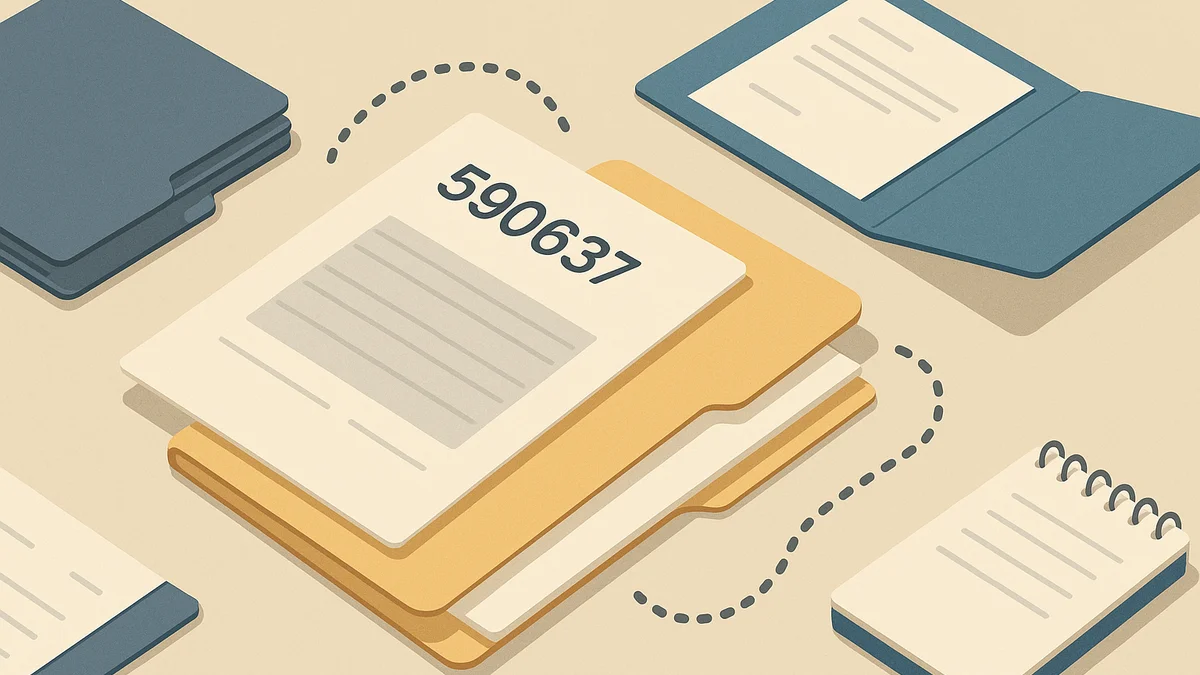
If 590637 has turned up in your records, the number itself does not tell you very much. It could be an order number, a customer reference, a product code, a ticket number or an internal identifier. The useful question is not “what does 590637 mean?” on its own, but “where was this number used, and what job does it do?”
For most business owners, the task is practical: match the number to a document, an account, a payment or a support conversation, then use it to get the right person to look at the right record. This guide gives you a simple way to do that without wasting time or giving out more information than necessary.
What 590637 is likely to be
A number like 590637 is usually a reference rather than a standalone fact. By “reference”, we mean any identifier a business uses to track a transaction, account, item or query. The same numeric string can be used in different systems, so context matters more than the digits themselves.
Common possibilities
- Order number – used to track a purchase, delivery or fulfilment process.
- Reference code – a general label attached to a case, payment, complaint or booking.
- Product code – used in stock, catalogues or supplier systems to identify an item.
- Internal identifier – a number used by a business’s own software or records, often not meaningful outside that system.
In practice, you are usually trying to answer one of three questions:
- What is this number attached to?
- Which organisation created it?
- What should I do with it next?
How to work out whether 590637 is an order number, reference code, product code or internal identifier
The fastest way to identify a number is to look at how it appears. The surrounding words, the document type and the place you found it often narrow it down straight away.
| Where you found it | What it is probably doing | What to check next |
|---|---|---|
| Invoice, receipt, dispatch note | Order or payment reference | Supplier name, invoice date, line items, payment amount |
| Customer portal or account dashboard | Case, account or booking reference | Account holder name, status, linked order or service |
| Product label, catalogue, stock sheet | Product or item code | SKU, description, size, colour, supplier part number |
| Email subject line or support thread | Support ticket or case number | Company name, issue summary, date of contact |
| Spreadsheet, database export or admin tool | Internal identifier | Field labels, row headings, system name, user notes |
Clues that point to an order number
An order number is usually tied to a purchase. You will often see it beside a customer name, delivery address, invoice total or tracking information. If 590637 appears next to words like “order”, “dispatch”, “fulfilled”, “shipped” or “paid”, it is probably part of a purchase trail.
Clues that point to a reference code
A reference code is broader and more flexible. It may appear in customer service messages, claims forms or bank correspondence. If the number is shown with language such as “quote this reference”, “case ref” or “your reference”, it is probably there to help another team find the right record quickly.
Clues that point to a product code
Product codes are often used with descriptions, variants and stock details. If 590637 appears on a product label or in a catalogue, check whether it sits alongside a product name, size or model number. Some suppliers use several identifiers for the same item, so 590637 may only be one of them.
Clues that point to an internal identifier
Internal identifiers are designed for the business’s own systems. They may be short, numeric and not obviously descriptive. If you found 590637 in software, a report or a back-office export, it may only make sense inside that system. In that case, the surrounding record matters more than the number itself.
Where to look first: emails, invoices, receipts, account dashboards and printed paperwork
When you are tracing a number, start with the places most likely to contain the original transaction or conversation. Do not search every file at once. Work through the records in the order below.
1. Emails and email attachments
Search your inbox for 590637 and also for nearby clues, such as the supplier’s name, a subject line fragment or terms like “order”, “invoice”, “case” or “ticket”. Check both sent and received messages, because references often appear in replies rather than the first email.
Open attachments as well. An invoice PDF or delivery note may contain the number even when the email body does not.
2. Invoices and receipts
Invoices are one of the most common places to find a reference trail. Look for:
- invoice number
- purchase order number
- customer reference
- line item descriptions
- payment status
A receipt may show only a transaction ID or shortened reference. If 590637 appears on a receipt, compare it with the amount, date and merchant name rather than relying on the number alone.
3. Account dashboards and supplier portals
If you have an online account, log in and check the order history, support history, billing area and downloads section. Many systems hide the important identifier behind a clickable record rather than displaying it on the front page. You may need to open the detail view for a single order or case.
4. Printed paperwork
Do not overlook paper records: delivery slips, letters, warranty forms, packing notes and supplier statements can all carry a reference. If you keep paper files, check the margin notes and barcode labels as well as the main text.
5. Stock, finance and admin spreadsheets
If your business keeps a central spreadsheet, search for the number across all tabs. Reference numbers often end up repeated in sales logs, bank reconciliation sheets and customer service trackers. A number that seems unhelpful in one sheet may be fully identified in another.
How to use the number safely when contacting customer service or your supplier
When you contact support, the aim is to help the other side find the right record quickly without creating confusion or exposing unnecessary information.
Share only what they need to locate the record
Start with the reference number, the date and the relevant company name. If asked, give the invoice number, order date, email address used for the account or the postcode on the delivery address. Avoid sending more than you need to unless the issue requires it.
Keep your message clear
A short, structured message is easier to process than a long explanation. For example:
“I am trying to trace reference 590637. I believe it may relate to an order or support case from last week. Could you confirm which record it belongs to and what the next step is?”
You are not claiming certainty. You are asking the supplier to match the reference against their own system.
Check you are speaking to the right organisation
If the reference came from an email or printed note, confirm the organisation name before sharing the number. A genuine-looking reference is not enough on its own. Make sure the sender, website or phone number is the one you expect to deal with.
Keep your own note of what you shared
Record who you contacted, when you contacted them, and exactly what you gave them. If the matter is delayed or passed to another team, this note saves time later.
What to check if the reference does not match anything in your records
If 590637 does not appear in your files, that does not necessarily mean the reference is wrong. It may mean you are looking in the wrong system, or that the number has been copied incorrectly.
Check for transcription errors
Numbers are easy to mistype, especially if they were copied from a screenshot, voicemail, handwritten note or low-quality printout. Look for:
- a missing digit
- an extra digit
- swapped digits
- spaces or punctuation that were omitted
Try searching for nearby combinations as well, but do this carefully so you do not create a false match.
Look for a different format
The identifier may not be only digits in the original record. Some systems use prefixes, suffixes or hyphens, such as a code with letters added before or after the number. If 590637 is part of a larger code, search for the full version, not just the numeric part.
Check whether the number belongs to a different business process
A single business may use separate numbers for orders, invoices, support cases and returns. If the reference does not match your order records, check finance, returns, complaints and account administration. The number may belong to a later stage of the process than you expected.
Consider that it may be an internal-only code
Some numbers are meaningless outside the originating company’s system. If you received 590637 from a supplier, they may need to interpret it for you. In that case, your task is not to decode it yourself but to give them enough context to trace it on their side.
How to avoid confusing similar codes in future by keeping a simple reference log
If your business handles multiple suppliers, customers or cases, a small reference log can save a lot of time. The point is not to build a complex database. It is to keep enough context beside each number so you can find it again.
Set up a simple log with a few useful fields
For most small businesses, a spreadsheet or shared notebook is enough. Use columns such as:
- reference number
- organisation or contact
- what it relates to
- date received
- invoice or order value, if relevant
- status
- where the original document is stored
That way, 590637 is not just a number. It is linked to a supplier, a date and a document location.
Use one rule for naming files
Save files in a consistent format, for example:
- 2026-01-Reference-590637-SupplierName
- Order-590637-Invoice.pdf
- Case-590637-EmailThread
Choose one pattern and apply it every time. Consistency matters more than style.
Keep the original and the summary together
Do not separate the reference from the supporting document. If the invoice lives in one folder and your summary note lives in another, you will waste time later. Keep a direct link, file path or cross-reference so you can get back to the source quickly.
Review the log regularly
At the end of each week or month, check for duplicates, incomplete notes and unclear labels. A log only helps if someone else can understand it later. If you are the only person who can decode the abbreviations, it is not much of a system.
Useful example: tracing 590637 from start to finish
Suppose you find 590637 in an email from a supplier and are unsure whether it refers to an order or a support case. You could work through it like this:
- Search your inbox for 590637 and the supplier’s name.
- Open the message thread and check whether it mentions an invoice, dispatch or query.
- Log in to the supplier portal and search the order and support sections separately.
- Check the invoice PDF and packing note for matching dates or amounts.
- If nothing matches, email the supplier with the number, your name, the date and the related email subject line.
That sequence is often enough to identify what the number is without escalating the issue unnecessarily.
Key takeaways
- 590637 is most likely a reference of some kind, not a self-explanatory fact.
- The context around the number usually tells you whether it is an order, product, case or internal identifier.
- Start with emails, invoices, receipts, dashboards and paper records.
- When you contact support, give the reference and the minimum supporting details needed to find the record.
- If nothing matches, check for copying errors, different formats and separate business processes.
- A simple reference log helps you avoid the same problem in future.
Quick checklist before you contact support
- Search your inbox and sent mail for 590637.
- Check invoices, receipts, packing notes and account dashboards.
- Look for clues such as “order”, “case”, “invoice”, “booking” or “ticket”.
- Confirm the organisation name before sharing the number.
- Send only the details needed to trace the record.
- Note who you contacted and what you shared.
If you still cannot place the number, go back to the original document and work from the surrounding information, not the digits alone.
Related business checklists
Related articles

What Documents Do I Need to Buy a Business in the UK?
Before you buy a business in the UK, the documents matter more than the seller’s pitch. This guide explains which records to ask for first, what they show, and how the list changes for share purchases and asset deals.
10 October 2026 · 11 min read
Small Business Cyber Incident Response Checklist
A practical checklist for small business owners to contain a cyber incident, decide who does what, preserve evidence, contact the right people and recover safely.
8 October 2026 · 9 min read
First employee checklist for UK small businesses
A practical, layout-friendly checklist for UK small businesses preparing to hire their first employee, covering structure, records, payroll, pensions and what to verify with official guidance.
29 September 2026 · 6 min read