What Documents Do I Need to Buy a Business in the UK?
Before you buy a business in the UK, the documents matter more than the seller’s pitch. This guide explains which records to ask for first, what they show, and how the list changes for share purchases and asset deals.
By Lucy Mitchell · Published 10 October 2026 · Updated 10 October 2026 · 11 min read
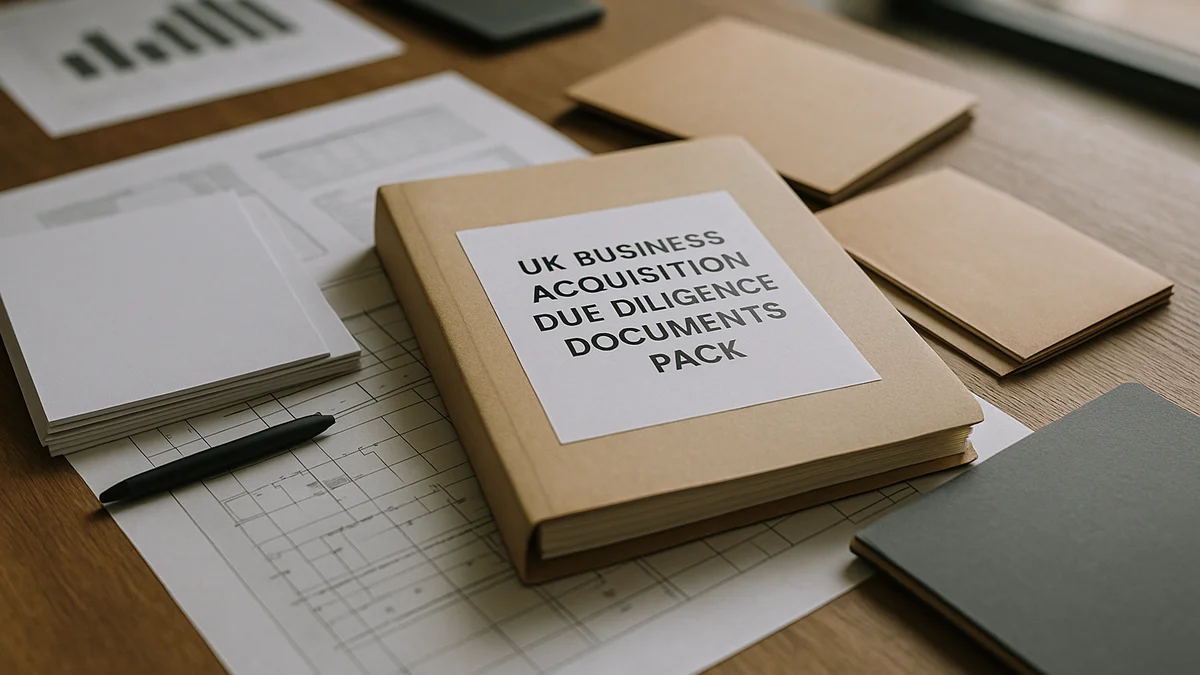
First-time buyers often get handed a thick pile of papers and assume that more paperwork means more protection. In practice, the useful documents are the ones that show who owns the business, what it earns, what it owes, who works there, and whether anything could stop the deal after you have signed.
The exact list depends on whether you are buying shares or assets, how large the business is, and the sector it operates in. A small retail shop, a limited company consultancy and a regulated trade business will not need exactly the same checks. But the logic is the same: start with the documents that prove ownership and authority, then move through the figures, contracts, tax, staff and compliance records before you agree to be bound.
That sequence matters because missing or inconsistent records are rarely just a paperwork issue. They often point to unfinished filings, hidden liabilities, disputed ownership or contracts that are less secure than they first appear.
Why the document pack matters before you agree a price
When you buy a business, the documents are your main way of testing what is actually being sold. A seller may describe strong turnover, loyal customers and manageable overheads, but the records tell you whether those claims stand up.
There is also an important difference between an asset purchase and a share purchase.
- In a share purchase, you are buying the company itself. That usually means you inherit the company’s liabilities as well as its assets, so company records and legal papers matter more.
- In an asset purchase, you are buying selected parts of the business: perhaps stock, equipment, contracts or intellectual property. That can be cleaner, but only if the paperwork clearly lists what is included and what is left behind.
GOV.UK explains that a limited company is legally separate from its owners and directors, and that company directors must keep records and file accounts and tax returns for the company. It also notes that the way a business is set up affects tax and legal responsibilities, which is why deal structure matters from the start.GOV.UK — Set up a businessGOV.UK — Set up a limited company
If the documents do not match the story you have been told, treat that as a warning sign. A missing lease, an unexplained director change or tax filings that do not line up with the management accounts may mean the business is still carrying problems that have not been fully disclosed.
The first documents to ask for straight away
Basic sale and identity documents
Before you spend time reviewing every contract and invoice, ask for the documents that confirm the seller can actually sell the business.
- Heads of terms or a draft sale agreement, if available.
- Proof of who owns the business or company.
- Evidence of who has authority to sign and complete the sale.
- Company number, registered office details and, if relevant, a group structure chart.
In a company sale, check the Companies House details against what the seller tells you. GOV.UK says limited companies must register before they start trading and that directors are responsible for keeping the company’s records correct, including information held at Companies House.GOV.UK — Set up a limited company
A simple example of why this matters
Suppose you are buying the business from one director who says they “run everything”. If the company has other shareholders, a business partner, a lender with security, or a shareholder agreement restricting transfers, that one person may not be enough to complete the deal. You could spend weeks negotiating a price only to find that someone else’s consent is needed.
That is why the first document request is not just administrative. It tells you whether the person across the table can legally give you what they are selling.
Financial documents that show whether the numbers add up
The financial pack should help you judge earnings quality, not just headline turnover. A business can look healthy on paper while still having weak cash flow, overdue tax, overdue supplier bills or personal costs running through the accounts.
Start with the most recent available records:
- Statutory accounts.
- Management accounts.
- Profit and loss statements.
- Balance sheets.
- Cash flow information, if available.
- Recent bank statements.
- Aged debtor and creditor lists.
- VAT returns and tax filings where relevant.
These documents should be read together, not separately. A good profit figure is less reassuring if the bank balance is weak or if several customers are paying late. Equally, a strong turnover figure means little if gross margin has been falling or if a key supplier relationship is unstable.
Ask what adjustments have been made to the figures. Common examples include owner salary, one-off legal costs, exceptional repairs, personal expenses run through the business, or transactions with a connected company. Those adjustments may be legitimate, but you need them explained clearly so you can judge the underlying performance of the business rather than the seller’s version of it.
If the seller is reluctant to share bank statements or recent management accounts, be cautious. That may mean the figures are not being monitored closely enough, or that the latest position is less comfortable than the headline accounts suggest.
Legal and contractual documents you should not ignore
Customer and supplier contracts
Ask for the key customer and supplier contracts, together with renewal dates, termination clauses and any change-of-control terms. Change-of-control provisions are clauses that allow the other party to act if ownership of the business changes. In some deals, that can be the difference between keeping a valuable contract and losing it after completion.
You do not necessarily need to read every routine purchase order, but you should review the agreements that matter most to revenue, supply continuity and business reputation.
Property and asset documents
Find out exactly where the business operates from and on what terms. That means checking the lease, title documents or licence to occupy. If the business uses vehicles, equipment, stock, software or branding, ask for the supporting documents that show who owns what and whether anything is being financed or leased.
- Lease or licence to occupy.
- Hire purchase, leasing or other finance agreements.
- Ownership proof for major equipment and vehicles.
- Stock records where stock is material.
- Intellectual property documents, such as trade mark registrations or assignments, if relevant.
The trade-off here is straightforward. If you want to move quickly, you may be tempted to skim the contracts and trust that “nothing important” is hidden in the small print. But the small print is often where the business is most exposed. A lease break clause, a financing charge or a licence restriction can change the value of the whole deal.
Claims and restrictions
Ask whether the business is involved in any disputes, warranties, guarantees, loans, charges, liens or pending claims. Charges and security interests can affect what assets are actually available to you. Guarantees can create obligations that survive beyond the sale. Pending claims can turn into immediate cash costs after completion.
You do not need to treat every issue as a deal-breaker. Some problems can be priced in, insured against or handled through contract wording. But you should know about them before you commit, not after the money has changed hands.
If you are buying shares, look harder at company records
In a share purchase, the company continues to exist and you are buying into its legal history. That means the records must show that the company is properly constituted and that the shares being sold are validly owned and transferable.
Ask for:
- Share certificates.
- The register of members.
- The articles of association.
- Board minutes and shareholder resolutions relevant to the sale.
- Confirmation of directors.
- PSC information.
- Any shareholders’ agreement.
PSC means “people with significant control”. In plain English, it identifies the people who control the company in practice, not just on paper. GOV.UK says companies must identify PSCs, for example anyone with more than 25% of the shares or voting rights, and confirm these details when registering with Companies House.GOV.UK — Set up a limited company
That matters because a share deal usually brings the company’s liabilities with it. If the accounts are incomplete, the filings are late or the shareholder position is messy, you are not simply buying the trading business; you are buying its corporate history too.
If you are buying assets, check exactly what is included
An asset purchase can be simpler than a share purchase because you can choose what you want to buy and leave behind what you do not. That is useful if the seller has old liabilities, dormant brands or a company shell that you do not need. But a cleaner structure only works if the sale documents are specific.
Ask for an asset schedule showing what is sold and what is excluded. If the business relies on items that are easy to overlook, check whether the transfer documents are in place for:
- Stock.
- Equipment.
- Vehicles.
- Domain names.
- Software licences.
- Customer lists, where transferable.
- Intellectual property.
Do not assume that a business “includes the website” or “comes with the customer database” unless the paperwork says so and the relevant rights can legally be transferred. If a licence is non-transferable, you may need a fresh agreement in your own name or company name after completion.
The simplest question to ask is: if I pay for this deal and the seller walks away tomorrow, what exactly do I own?
Employment and people documents
Staff records matter because people are often one of the biggest costs and one of the most sensitive transition risks in a purchase.
Ask for:
- A staff list with roles, pay, holiday balances and length of service.
- Employment contracts.
- Staff handbook or policies.
- Pension information.
- Any disciplinary or grievance issues.
- Details of bonuses, commission arrangements or informal promises.
If the business has employees and the deal means staff move over to you automatically, TUPE may apply. TUPE is the set of rules that can transfer employees and their existing terms and conditions when a business changes hands. Put simply, if TUPE applies, you need to understand who is transferring, on what terms, and what liabilities may come with them.
That includes holiday pay, notice periods, unresolved disputes and pension obligations. A business that looks manageable on the balance sheet can become less attractive if several staff have long service, unusual contractual terms or outstanding grievances.
GOV.UK also notes that taking on employees brings wider responsibilities, including payroll and workplace pension duties for eligible staff.GOV.UK — Set up a limited company
Tax, compliance and regulatory documents
Tax and compliance papers tell you whether the business has been keeping up with its legal duties, not just its commercial ones.
Ask for:
- HMRC correspondence.
- VAT registration details.
- PAYE records.
- Insurance policies.
- Licences and permits.
- Sector-specific approvals.
- Data protection policies, where the business handles personal data.
- Any records of past data breaches or compliance incidents, if disclosed.
GOV.UK says some businesses must register for VAT if they meet the requirements, and that limited companies may need to register for Corporation Tax and comply with other rules depending on what they do. It also notes that businesses may need licences or permits and, where personal information is handled, must follow the relevant rules.GOV.UK — Set up a businessGOV.UK — Set up a limited company
Missing compliance papers can create immediate cost even if the trading figures look fine. A business may be profitable yet still need urgent spend on insurance, permit renewals, payroll corrections, data protection fixes or backdated tax work. That is why compliance is not a box-ticking exercise; it is part of the purchase price in practical terms.
How to review the papers without getting buried
A long document list is manageable if you review it in a structured way. The risk is not only missing something important; it is getting overwhelmed and failing to compare like with like.
A practical approach is to divide the request list into five buckets:
- Finance.
- Legal.
- Tax.
- Staff.
- Assets.
Then ask for documents in date order where possible. That helps you compare the latest accounts against the latest bank statements, the latest lease terms against the latest rent obligations, and the current staff list against payroll and holiday records.
Look for inconsistencies early. For example, if the accounts show one business structure but the contracts are signed by another entity, you need to understand why. If a seller says a customer is key but there is no signed agreement, you need to know whether that customer can leave easily. If stock is meant to be included but the schedule is vague, the asset list needs tightening before completion.
This is where an accountant and solicitor can each add value in different ways. An accountant is more likely to spot earnings quality issues, unusual adjustments and missing tax patterns. A solicitor is more likely to pick up ownership, contract, transfer and liability risks. The point is not to duplicate the same review twice, but to divide it sensibly.
One useful habit is to turn every issue into one of three questions:
- Can this be fixed before completion?
- Can this be covered in the price or contract wording?
- Is this serious enough to walk away?
That keeps the review practical. Not every problem is fatal, but every unexplained problem deserves a decision.
A practical checklist before you make an offer binding
- Confirm whether you are buying shares or assets.
- Identify the seller and confirm who can sign.
- Review the latest financial accounts, management accounts and bank information.
- Check customer, supplier and property contracts.
- Ask for debt, charge, guarantee and claim information.
- Review staff records, contracts and pension obligations.
- Check tax filings, VAT, PAYE and regulatory approvals.
- Confirm what is included and what is excluded from the sale.
- Ask which documents are missing and why.
- Decide whether any gaps should change the price, warranties or completion conditions.
If the seller cannot provide a document, ask for the reason in writing. Sometimes the explanation is harmless. Sometimes it reveals an issue you would otherwise have discovered only after completion.
Use the documents to shape the deal, not just to admire it
The aim of due diligence is not to create the thickest file. It is to understand the business well enough to buy it on terms that reflect reality.
If the records are clean, you may be able to move quickly. If there are gaps, you may still be able to proceed, but only after adjusting the price, narrowing what you are buying, adding warranties or making completion conditional on particular documents being produced. If the gaps are serious and cannot be explained, walking away can be the most commercial decision.
Do not start with the price. Start with the documents that show what you are actually buying.
Next action: build a request list under five headings — finance, legal, tax, staff and assets — and send it before you make a binding offer. If the seller cannot supply a core document, note the gap, ask why it is missing and decide whether that affects the price or the deal itself.
Useful related reading: First employee checklist for UK small businesses | Small Business Cyber Incident Response Checklist
Related articles

How to Trace the Number 590637 in Your Business Records
If 590637 has appeared on an email, invoice, receipt or dashboard, this guide shows you how to work out what it is, where to look next and how to use it safely when you contact support.
9 October 2026 · 10 min read
Small Business Cyber Incident Response Checklist
A practical checklist for small business owners to contain a cyber incident, decide who does what, preserve evidence, contact the right people and recover safely.
8 October 2026 · 9 min read
First employee checklist for UK small businesses
A practical, layout-friendly checklist for UK small businesses preparing to hire their first employee, covering structure, records, payroll, pensions and what to verify with official guidance.
29 September 2026 · 6 min read