What should a business plan include in the UK?
A useful UK business plan is not a box-ticking exercise. It should explain what you sell, who will buy it, how you will make money, how the business will run, and what could go wrong — with enough detail for the reader to make a decision.
By Emma Collins · Published 11 October 2026 · Updated 11 October 2026 · 15 min read
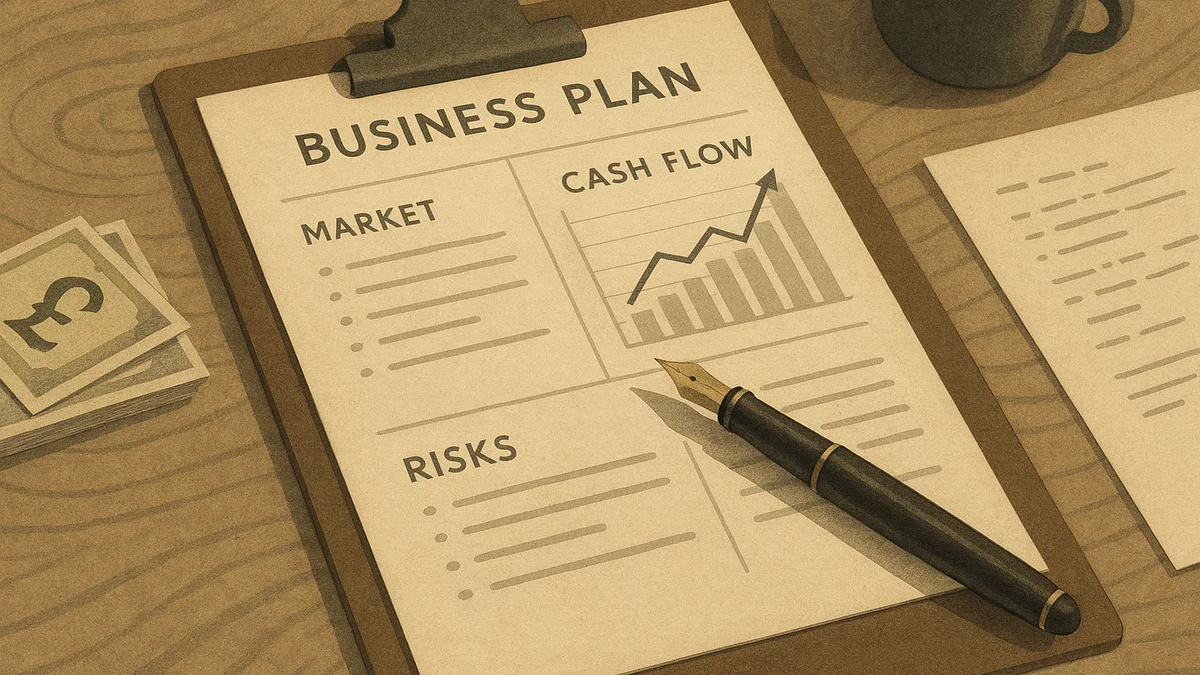
A business plan can fail in two opposite ways. It can be so vague that nobody can tell whether the business will work. Or it can be so long and padded that the reader gives up before reaching the numbers. The right plan sits between those extremes: clear enough to support a real decision, but focused enough that someone will actually read it.
What a business plan should include in the UK depends on who will read it and what they need to decide. A lender may want to see whether the business can repay borrowing. An investor may want to understand the growth case and the team. A supplier may want reassurance that you can trade reliably. If you are writing the plan for yourself, you still need the same core building blocks: a clear offer, a real market, a workable operating model, realistic financials and honest risks.
As a starting point, it helps to remember that your legal structure affects how the business is set up and run. GOV.UK notes that most businesses register as a sole trader or limited company, and that the structure you choose can affect tax, legal responsibilities and record-keeping. The details you include in your plan should match the structure you have chosen, or are planning to choose, and the obligations that come with it: https://www.gov.uk/set-up-business and https://www.gov.uk/limited-company-formation.
Start with the reader, not the template
Before you open a template, decide who the business plan is for. That choice changes both the content and the level of detail.
- A bank or lender will usually care most about repayment, cash flow, security, trading history and your ability to manage the business sensibly.
- An investor will usually want the market opportunity, growth potential, team strength, margins and exit potential.
- A supplier or partner will want to know whether you are reliable, solvent and operationally organised.
- You, as the owner, may want a practical working document that tests whether the business can actually function.
This is why the same plan should not be written in exactly the same way for every audience. A lender may be happy with concise evidence of demand and a tight cash forecast. A potential investor may need a fuller explanation of the market and competitive position. A joint venture partner may need more detail on decision-making, ownership and responsibilities.
The rule is simple: include enough information for the reader to make the decision they need to make, and no more. Extra pages are not a substitute for evidence.
Begin with the essentials at a glance
The opening section should let the reader understand the business quickly. This is where many plans go wrong. They either begin with a generic statement of ambition, or they bury the basic facts under marketing language. Start instead with a short executive summary and the facts that frame the rest of the document.
What to include in the first section
- Executive summary — a short overview of what the business does, who it serves, how it makes money and why the opportunity is credible.
- Business description — what the business is, what it sells, and what problem it solves.
- Legal structure — sole trader, partnership, limited company or another structure, as relevant.
- Location — where the business operates from, or whether it is remote, home-based or premises-led.
- Purpose — why the plan exists: funding, strategy, launch, expansion or review.
A weak summary says little more than: “We aim to become a leading provider of quality solutions in our sector.” That tells the reader almost nothing. A useful summary says who the customer is, what problem you solve, how you will make money and what evidence supports the plan.
Illustrative example: a weak summary for a local accountancy practice might say it will “serve businesses with modern financial services.” A more useful summary would say it will provide bookkeeping and year-end support to sole traders and micro-companies in a defined area, use fixed monthly fees, work from a home office initially, and rely on referrals and local networking to win clients.
Keep this section short, but not thin. The reader should be able to understand the business without needing to hunt through the rest of the plan.
Show that there is a real market
One of the main jobs of a business plan is to show that there is genuine demand. That does not mean inflating the market size or assuming you will capture it easily. It means explaining, in practical terms, who will buy, why they will buy, and what else they could buy instead.
Describe your target customer clearly
Do not write “everyone” or “small businesses” unless you can explain which small businesses, in which circumstances, with which needs. A useful customer description goes beyond broad demographics and looks at buying behaviour and pain points.
For example, if you sell software to independent retailers, say whether you are targeting start-ups, established independents, multi-site operators or a niche such as gift shops. If you run a trades business, explain whether your best customers are homeowners, landlords, commercial clients or a mixture. The more precisely you understand the customer, the easier it is to judge demand and pricing.
Explain demand drivers
Set out why customers need the product or service now. That could be a regulatory requirement, a cost-saving, convenience, a quality gap in the market, or a change in how people buy. Keep the explanation grounded. If you believe demand will grow, say what is driving that growth rather than simply asserting it.
Be careful not to overstate the market. A common mistake is to describe the total market as if it were the accessible market. Those are not the same thing. The total market may be large, but your business may only be able to reach a narrow slice of it because of geography, price point, distribution, capacity or brand awareness.
Cover competitors honestly
Every real business has competition, even if it is indirect. Customers can always choose to do nothing, buy from a larger competitor, or use a substitute. The business plan should say who else serves the same customer and why your offer is better or different.
That difference might be price, speed, quality, service, specialist knowledge, convenience or a combination. Avoid claiming that you have “no competition”; it usually suggests the market has not been properly assessed.
If you want a more structured way to set this out, our guide to How to write a practical business plan goes into how to keep the market section focused and decision-ready.
Explain the offer and how money will be made
A business plan should make the commercial model easy to understand. In plain terms, what are you selling, to whom, at what price, and with what margin left after direct costs?
Set out the offer clearly
Describe the product or service in practical language. If the offer is still being developed, say what stage it is at and what remains to be finished. If there are different products, packages or service tiers, explain the differences and which customers each one is for.
The reader should also be able to see whether the offer is one-off or repeat business, bespoke or standardised, and whether it can be delivered at scale. That matters because a business that sells many small, repeatable transactions often needs a different operating model from one that sells fewer, higher-value projects.
Be explicit about pricing and margins
Your plan should show how pricing works. Is it fixed fee, hourly, subscription, commission-based, usage-based or a mix? If pricing changes by customer type, explain why. You do not need to publish every commercial detail, but the pricing logic must be visible.
Margin matters as much as revenue. A business can look busy and still struggle if the direct cost of delivery is too high. In a service business, direct costs may include contractor fees, software licences or travel. In a product business, they may include stock, shipping, packaging and duties. Show how much is left after those costs before overheads are added.
Use a simple example for each model
Service business example: a marketing consultant may charge a monthly retainer for a fixed number of deliverables, with occasional project work charged separately. The plan should explain what is included, how long contracts typically last, how clients are won, and what portion of work is done personally rather than outsourced.
Product business example: a small food brand may sell through its own website and independent retailers. The plan should show retail price, wholesale price, unit cost, gross margin and how stock will be funded between ordering and sale.
Where revenue is recurring, make that plain. Recurring revenue can improve visibility, but only if customers actually stay and pay. A subscription model with high churn is not as secure as it first appears.
Describe how the business will operate
Many plans cover sales and financials well, then wave away the question of how the business will actually function. That gap matters. A good operating model turns the offer into a workable business.
Cover the practical moving parts
- Premises — home-based, rented office, workshop, warehouse, retail unit or mobile delivery model.
- Suppliers — who provides stock, materials, software or outsourced services, and how dependent you are on them.
- Delivery — how orders are fulfilled, services delivered or jobs completed.
- Systems — accounting, stock control, customer management, booking, e-commerce or other core software.
- Staffing — who does the work now and what capacity will be needed later.
This section is also where you should mention UK legal or regulatory points that matter to your business. GOV.UK notes that some businesses need licences or permits, business insurance, and compliance with rules on personal information, online selling, imported goods or trading from home or rented premises. Limited companies also have responsibilities around records and accounts, and may need to register for VAT if they meet the requirements: https://www.gov.uk/limited-company-formation.
Do not pad this section with every possible rule. Focus on the ones that are relevant. A café and a software consultancy do not face the same operational issues, and the plan should reflect that.
Practical trade-off: if you want to keep overheads low by working from home, explain whether that limits storage, client meetings or delivery capacity. If you want premises, explain why the location supports trade and how the fixed cost will be covered.
Set out the team and responsibilities
Backers often lend to people as much as to business ideas. Even if the business is early-stage, the plan should show who is responsible for what and where the gaps are.
Include the main founders, directors or owners, and explain their roles in simple terms. This is not the place for overblown biographies. It is the place to show relevant experience, sector knowledge, sales ability, operational skill or financial control.
What the team section should answer
- Who makes the key decisions?
- Who sells, who delivers, who manages cash and who handles compliance?
- What experience do the founders bring that reduces risk?
- What skills are missing at the moment?
- Will you use advisers, contractors or future hires to fill those gaps?
It is better to admit a gap than to imply the team can do everything already. If you need an accountant, solicitor, non-executive adviser, sales contractor or technical consultant, say so. The reader will often have more confidence in a plan that is candid about what is missing and how it will be covered.
If the business is a limited company, it may also be useful to show who the directors are and how responsibilities will be divided. GOV.UK says a company is legally separate from its owners and that directors have responsibilities for records, accounts and filings. That does not mean you need to list every compliance task in the plan, but you should show that someone is accountable for them: https://www.gov.uk/set-up-business.
Include realistic financial forecasts
This is often the section readers turn to first, and it is where many plans are weakest. A neat spreadsheet is not enough. The numbers need to fit the story in the rest of the plan.
The key figures to include
- Start-up costs — what you need to spend before trading or to reach your first stage of growth.
- Profit and loss forecast — projected sales, direct costs, overheads and profit.
- Cash flow forecast — when money comes in and goes out.
- Break-even point — the level of sales at which the business covers its costs.
- Funding needed — how much money is required, when, and what it will be used for.
- Assumptions — the drivers behind the numbers, such as sales volumes, average order values, wage costs, rent or stock turns.
For an early-stage business, cash flow usually matters more than profit in the first months. A business can show an accounting profit while still running out of cash if customers pay slowly, stock must be bought in advance or large fixed costs fall due before income arrives. The plan should make that timing clear.
Be especially careful with assumptions. If you forecast 20 customers a month, show why that is credible. If you expect to raise prices, explain why customers will accept it. If you assume stock turns quickly, show what supports that view. The purpose is not to pretend certainty; it is to show that the numbers are thought through.
Helpful approach: include a base case, and if the plan is for funding or investment, consider a more cautious version as well. That helps the reader see how resilient the business is if sales arrive more slowly than hoped.
For a small company plan, our guide on How to write a business plan for a small company in the UK may help you keep the financial section useful rather than overcomplicated.
Cover risks and what you will do about them
A credible plan does not pretend the business is risk-free. It identifies the main threats and shows how you will reduce or manage them. That gives the reader more confidence than a glossy document that ignores obvious weak points.
Common risks to address
- Customer concentration — too much turnover depending on one or two clients.
- Supplier reliance — dependence on a single supplier, manufacturer or software provider.
- Delivery delays — problems in stock, fulfilment, staffing or project management.
- Cash shortfalls — slow-paying customers, seasonal trading or unexpected costs.
- Founder dependency — the business relies too heavily on one person for sales, operations or technical knowledge.
For each significant risk, set out the mitigation. That might mean taking deposits, using more than one supplier, holding reserve cash, writing procedures, insuring where sensible, or training another person to take over a critical task.
Do not create false reassurance. A risk section is more useful if it is specific and practical than if it is full of broad statements about “monitoring the situation”. The reader should be able to see what you will actually do if the risk appears.
If you want a more structured way to manage these issues after the plan is written, our article on How to Create a Practical Business Risk Register may help.
Decide how long the plan should be and what to leave out
There is no single correct length for a business plan. The right answer depends on the audience, the stage of the business and the decision at stake.
A lender-ready plan can often be more concise if the business model is straightforward and the figures are clear. An investor-facing plan may need more detail on the market, the team and growth strategy. A new business plan may be longer because it has to explain the assumptions from scratch. A plan for an established business may be shorter if much of the background is already known.
The important point is that clarity beats padding. Do not repeat the same information in different sections just to make the document look substantial. Do not include every possible idea, product or future ambition if it distracts from the core case. A plan is stronger when it answers the questions that matter and leaves out the rest.
Useful things to leave out or cut back include:
- generalised market language that does not support the proposal;
- product features that do not affect the buying decision;
- overly technical detail the reader does not need;
- unsupported claims about demand or growth;
- long personal histories that do not help explain capability.
If you are unsure, ask whether a sentence helps the reader decide. If it does not, it probably belongs in an appendix or nowhere at all.
Use the right amount of detail for each audience
One practical way to judge detail is to ask what evidence the reader needs to trust the next step. A bank may want clear evidence that the business can service debt. An investor may want to know how large the opportunity could become. A trading partner may want confidence that the business is properly organised and likely to pay on time.
That means some sections can be brief while others need more depth. For instance, a simple owner-managed service business may need only a short legal and operational section, but a more complex product business may need fuller detail on supply chain, stock management and margins. Likewise, an early-stage business may need stronger explanation of assumptions than a long-established firm with trading history.
If the audience is mixed, write the main plan for the most important reader and use appendices for supporting detail such as CVs, product specifications, market research or detailed spreadsheets. That keeps the main argument readable without hiding evidence.
Finish with a review checklist
Before you send the plan, check that it answers four questions clearly: what you sell, who will buy it, how you will make money, and what could go wrong. If any of those needs hand-waving, the plan is not ready yet.
- Is the executive summary short, specific and honest?
- Does the market section identify real customers and real competitors?
- Is the pricing model, margin and revenue stream clear?
- Have you explained how the business will operate in practice?
- Are the team, responsibilities and skill gaps stated plainly?
- Do the forecasts show the main assumptions and cash needs?
- Have you named the main risks and the steps you will take to manage them?
- Does the length fit the audience, without padding?
A business plan is not meant to sit in a drawer. It should help you make decisions, win support and spot weak points early. Update it when the business changes, not just when someone asks for a copy. If the offer, market, team or numbers move, the plan should move with them.
For UK founders and small business owners, the most useful plan is usually the one that is easiest to test. If the plan can clearly explain what you sell, who will buy it, how money comes in, and what could go wrong, it is doing its job. If not, trim it back, tighten the assumptions and try again.
Related articles

What records should a small business keep in the UK?
UK small businesses often keep too little, or far too much. The sensible answer is to keep the records that prove sales, costs, payroll, tax positions, contracts and compliance, then store them in a system you can actually use.
16 October 2026 · 16 min read
How to manage business cash flow during slow months
Slow months can expose weak cash flow even in healthy businesses. The answer is usually not blunt cuts, but better timing: forecast early, collect money faster, protect essential spending and use finance only when you know the size of the gap.
15 October 2026 · 11 min read
How to measure whether a small business is profitable
A business can look busy, generate sales and still fail to make real money. Here is a practical way to judge profitability using profit and loss, gross margin, overheads, cash flow and owner time without being misled by the bank balance.
13 October 2026 · 12 min read
How to choose KPIs for a small business
Too many small businesses track numbers that fill a dashboard but do not change decisions. The better approach is to choose a small set of KPIs that link to your goals, can be reviewed regularly and tell you whether day-to-day actions are working.
13 October 2026 · 14 min read
How to reduce operating costs without cutting staff
If costs are rising but your team is already stretched, the answer is usually not a blunt headcount cut. A better approach is to map spend, remove waste, renegotiate recurring costs, improve processes and use capacity more efficiently while protecting service and morale.
13 October 2026 · 13 min read
How to create standard operating procedures that staff use
Standard operating procedures only help if people can use them in real work. This guide shows how to choose the right processes, map the actual steps, write clear instructions, test them with staff and keep them current without creating bureaucracy.
13 October 2026 · 12 min read