What records should a small business keep in the UK?
UK small businesses often keep too little, or far too much. The sensible answer is to keep the records that prove sales, costs, payroll, tax positions, contracts and compliance, then store them in a system you can actually use.
By William Harris · Published 16 October 2026 · Updated 16 October 2026 · 16 min read
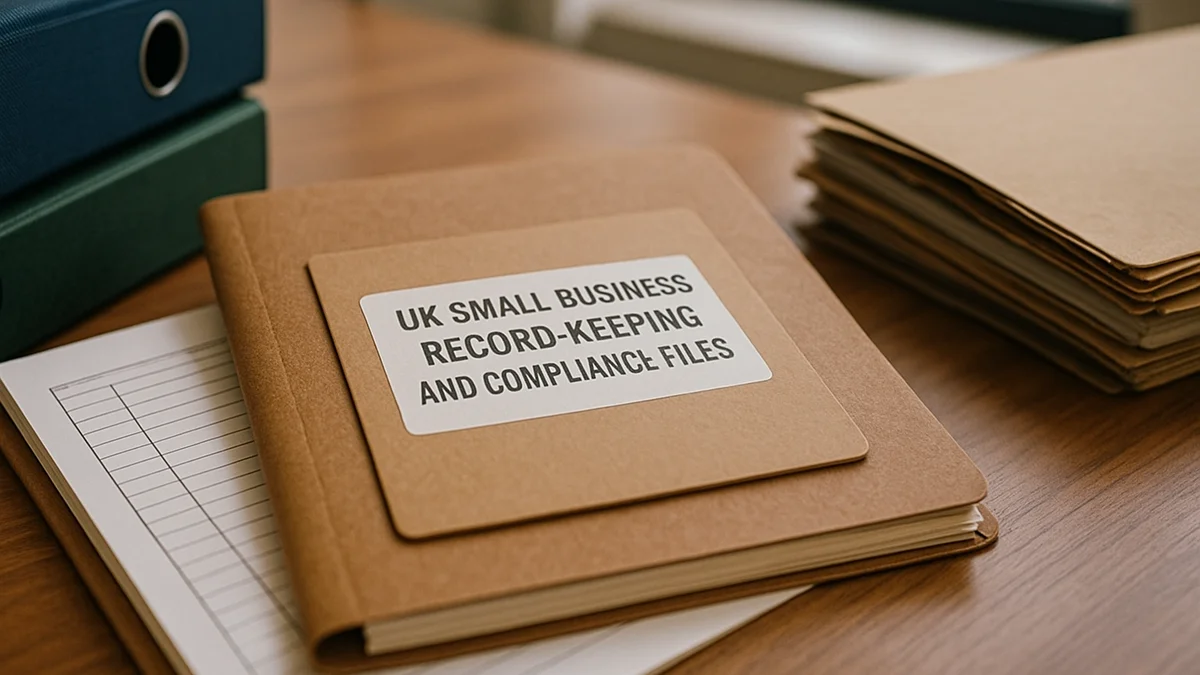
Start with the three questions that decide what you need to keep
Many small business owners worry that they are either keeping too little or drowning in paperwork they do not need. That is a sensible concern. If you keep too few records, you may struggle to back up a tax return, answer a query from HMRC or prove what happened in a dispute. If you keep everything without any system, you waste time finding simple documents and make it harder to see what matters.
The practical answer depends on three things:
- Your business structure — sole trader, partnership or limited company.
- Your obligations — for example Self Assessment, VAT, payroll, Corporation Tax or sector-specific rules.
- What the record is for — proving income, costs, employment, ownership, compliance or a contractual right.
That last point is often missed. Some records are mainly for tax and legal compliance. Others are mainly for management, such as monthly reports or KPI tracking. Useful management records can help you make decisions, but they are not always the same as the records you must keep.
GOV.UK notes that most businesses register as a sole trader or limited company, and that the structure you choose affects tax and legal responsibilities. It also says that when you start trading you must keep records, and that directors of limited companies have responsibilities to keep company and accounting records and file accounts and tax returns for the company. GOV.UK — Set up a business
So the aim is not to create a vast archive. It is to keep enough evidence that you can explain every important sale, purchase, payment and decision.
The core records every small business should keep
Whatever the size of your business, there is a basic set of records that usually matters. These are the records that show money moving in and out, and they are the starting point for most tax and management questions.
Sales invoices and proof of income
Keep copies of invoices issued to customers, and any supporting records that show what was sold, when it was sold and whether it was paid. If you use card terminals, online payment platforms or manual invoicing, the key point is the same: you should be able to trace the sale from the original transaction to the banked money.
A useful sales record normally shows:
- the date of the sale or invoice
- the customer’s name or trading name
- the amount charged
- what was supplied
- the VAT position, if relevant
- whether the invoice has been paid
For a service business, the description of the work matters almost as much as the amount. “Consulting services” may be enough for your bookkeeping software, but it may not be enough on its own to explain why the fee was earned.
Purchase receipts and supplier invoices
Keep the evidence for what you buy for the business, from stationery to stock, software to subcontracted work. This matters because expenses are not just figures in a spreadsheet; they need support. A bank payment alone shows that money left the account, but not what it was for or whether it was business-related.
Try to keep the original supplier invoice or receipt, together with any order confirmation or delivery note where that helps explain the purchase. If you buy the same item regularly, good naming and filing become more important, not less.
Bank statements and payment records
Bank statements are central because they show the actual movement of money. Keep them for all business accounts, plus records for payment services if customers pay through platforms or merchant facilities.
Bank records help you:
- match invoices to payments
- spot missing income or duplicate costs
- reconcile your bookkeeping to real balances
- support a cash flow review
In practice, bank records are often the quickest way to resolve a mismatch between what your bookkeeping shows and what is really in the account.
Expense records and mileage logs
For travel, motoring and mixed-use costs, keep a clear note of the business purpose. Mileage logs are especially useful if you use your own vehicle for business. A good mileage record should show the date, journey start and end points, miles travelled and the reason for the trip.
Where an expense has both business and personal elements, such as a phone bill or home office use, the record should support the business proportion you claim. The exact treatment depends on the tax rules that apply to your business, but the underlying principle is always the same: be able to explain why the business paid what it paid.
Petty cash records
If your business still uses petty cash, keep a simple log of every payment in and out, with receipts where possible. Small cash spends are easy to lose, and when they are added together they can become a surprising source of error. Even a basic petty cash sheet is better than a tin of receipts with no dates.
Accounting software exports and backups
If you use accounting software, keep exports or backups of your records in a format you can still access later. Software is convenient, but it should not be the only place your records exist. Systems change, subscriptions lapse and formats become outdated.
A good export should let you rebuild the picture if the software is unavailable. That means keeping reports, transaction lists and year-end summaries as well as the source documents behind them.
Tax records HMRC is likely to expect
Tax records are really about evidence. HMRC is not just interested in a total on a return; it may need to see how that total was worked out. The exact records vary by tax, but the common thread is that you should be able to support the figures you submit.
Self Assessment and income records
If you are a sole trader or partner, your business profits are usually reported through Self Assessment. You therefore need records that show income, expenses and adjustments clearly enough to support the figures on your return.
In practical terms, that usually means keeping:
- sales records
- purchase records
- bank statements
- expense evidence
- records of business assets bought or sold
- details of any private use adjustments
If you are unsure whether a cost is deductible, keep the evidence anyway and note the business reason. That will help your accountant or adviser decide how it should be treated.
Corporation Tax records for limited companies
Limited companies need records that support the company’s accounts and Corporation Tax position. GOV.UK says directors have responsibilities to keep company and accounting records and file accounts and tax returns for the company. GOV.UK — Set up a limited company
For a limited company, this usually means keeping records of:
- sales and purchase ledgers
- bank transactions
- fixed asset purchases and disposals
- director’s loans and other amounts owed by or to directors
- dividends and salary paperwork
- accounting adjustments and journals
Small companies often assume that tidy management accounts are enough. They are useful, but they do not replace the underlying documents. If a figure on the accounts is challenged, you need the evidence behind it.
VAT records
If you are VAT registered, keep records that allow you to show the VAT charged on sales and the VAT reclaimed on purchases. That means retaining VAT invoices where they are required, as well as enough detail to explain the tax treatment of each transaction.
Useful VAT records normally include:
- sales invoices showing VAT where applicable
- purchase invoices and receipts
- import or export paperwork if relevant
- records of exempt, zero-rated or partly exempt supplies where relevant
- the figures used to complete your VAT returns
The point is not just to total the VAT due. It is to show how the return was built, transaction by transaction, if anyone asks.
CIS records where relevant
If your business works under the Construction Industry Scheme, keep records that show payments to subcontractors, deductions made and CIS statements received or issued where required. This is one area where paperwork often goes missing because several parties are involved. The safer approach is to file the contract, invoice and deduction evidence together.
Evidence for expenses and capital purchases
Some costs are day-to-day expenses; others are capital purchases, such as equipment or tools that last beyond a short period. Keep records for both. The tax treatment may differ, but the evidence problem is the same: you need to show what was bought, when, from whom and for what purpose.
If a purchase is partly private and partly business-related, keep enough detail to support the apportionment you use. A neat total without a clear explanation can cause more trouble than a slightly messy file with a proper audit trail.
Payroll and staff records if you employ people
Once you employ staff, record-keeping becomes more sensitive. You need to be able to show how pay was calculated, what deductions were made and what rights or obligations applied during the employment relationship.
Payroll records
Payroll records are the records that show how you paid people. These are different from general HR files. Payroll records focus on money: gross pay, deductions, net pay, tax and National Insurance, pension contributions and any other amounts taken or paid through payroll.
Keep records of:
- wages and salaries
- PAYE calculations
- Real Time Information submissions, where used
- statutory payments such as sick pay or maternity pay, if relevant
- pension deductions and employer contributions
- final pay and leaving dates
If you use payroll software, keep exports or reports that show how pay was worked out. A payslip alone is helpful, but it is not always enough to reconstruct the calculation later.
Auto-enrolment and pension records
If your business has workplace pension duties, keep records of assessments, opt-ins or opt-outs, employer contributions and communications with the pension provider. These records matter because pension duties are not just a monthly deduction exercise; they are a compliance obligation with documentation attached.
Hours worked, leave and working patterns
Where hours matter, such as for hourly paid staff, overtime, or certain holiday pay calculations, keep records of hours worked, leave taken and any variations in agreed working patterns. If pay is disputed, the hours record may matter as much as the payslip.
Right to work evidence and employment documents
Keep evidence that a worker had the right to work in the UK where required, together with contracts and any documents that affect pay or status. If a dispute arises about employment terms, the contract is often the first document everyone wants to see.
It is also sensible to keep disciplinary or grievance documents where they affect pay, dismissal, bonuses or other employment rights. These are not just HR paperwork; they may become evidence in a claim or investigation.
Company and governance records for limited companies
If you run a limited company, some records matter even if you are the only director and shareholder. This is because the company is a separate legal entity. The paperwork is not a formality; it is part of how the company proves who decided what, who owns what and how money was taken out.
Company registers and filings
Keep the company’s core records, including its statutory registers and filings. GOV.UK says directors must check the information Companies House has about the company in a confirmation statement and file accounts and tax returns for the company. GOV.UK — Set up a limited company
At a practical level, that means keeping copies of:
- confirmation statements
- company accounts and tax returns
- records of shareholders and PSCs, where relevant
- changes to directors or registered office details
- company documents filed with or kept for Companies House
If the company is small and closely held, it is tempting to assume these records do not matter much. They do. A missing filing or inconsistent record can create avoidable problems later, especially if you sell the business, seek finance or face a dispute.
Board minutes and shareholder decisions
Keep minutes or written resolutions for important decisions, even if there are only one or two people involved. This includes decisions about borrowing, dividends, appointing directors, buying major assets or changing the company’s approach to key risks.
A written decision record is useful because it shows not only what was decided, but why. That can matter if the decision is questioned later by a lender, investor, tax adviser or another shareholder.
Dividend paperwork and director’s loans
If the company pays dividends, keep the paperwork that supports them. Dividends should not be treated as casual drawings. They need proper records showing the amount declared and the basis on which they were paid. Similarly, keep director’s loan records if money is lent to or from a director, because these balances can become awkward quickly if no one tracks them carefully.
Contracts and loan agreements
For a limited company, contracts and loan agreements are part of the governance record as well as the commercial record. They show who agreed what, on what terms, and when. If your company borrows money or signs a lease, the paperwork should be easy to find later.
Contracts, licences and insurance documents that protect the business
Not all important records are about accounting. Some are about rights, obligations and risk. These documents often matter most when something goes wrong: a customer disputes a bill, a supplier fails to deliver, premises are damaged or an insurer asks for evidence.
Supplier and customer contracts
Keep signed contracts, order terms, statements of work, service agreements and accepted quotations. If you sell on standard terms and conditions, keep the version in force for each deal, not just the latest copy. That way you can see which terms applied at the time.
Contracts matter because they set the commercial rules. They show payment terms, deliverables, termination rights, liability limits and what happens if either side misses an obligation.
Lease documents and premises records
If you rent a shop, office or workshop, keep the lease, any side letters, rent review notices, repair obligations and correspondence with the landlord. Premises paperwork can affect both cash flow and legal exposure, so it should be filed with the same care as tax records.
Licences, permits and sector permissions
Depending on what you do, you may need licences or permits to trade. GOV.UK notes that some businesses need licences or permits, for example to play music, sell food or trade in the street. GOV.UK — Set up a limited company
Keep copies of those permissions, renewal reminders and any conditions attached to them. If a licence is central to the business, losing track of the paperwork can stop trading or create enforcement problems.
Insurance schedules and policy documents
Insurance records are worth keeping because they show what cover you had, when it started, what risks were included and what exclusions applied. That matters when you make a claim, renew cover or respond to a dispute about whether something was insured at the time.
If you want to think more broadly about cover, it can help to review a separate guide on what business insurance a small company needs in the UK.
How long to keep records and where people go wrong
There is no single neat answer to how long every record must be kept, because the right period depends on the record type, the tax treatment and the legal structure of the business. That is why blanket rules tend to cause problems.
For practical purposes, think in ranges rather than absolutes:
- Tax and accounting records often need keeping for several years after the end of the relevant period.
- Payroll and employment records may need different retention periods from tax records.
- Company records can need longer retention, especially where they support decisions, ownership or long-running obligations.
- Contracts, leases and insurance documents should usually be kept for as long as they may still create rights or claims, and for a sensible period afterwards.
The mistake many small businesses make is either to delete things too soon or to keep everything in an untidy pile forever. The first creates risk; the second creates clutter. The right balance is a retention policy you can actually follow, with one place for current records and a separate archive for older material.
A useful rule of thumb is this: if a document could be needed to support a tax return, explain a payment, defend a claim or prove a right, do not throw it away casually. If it has no ongoing business purpose, move it to an archive or delete it in line with your policy.
Paper, spreadsheets or software: choosing a sensible system
The best record-keeping system is the one you will actually use. A perfect system on paper is useless if nobody updates it. A highly automated system is also unhelpful if it produces records you cannot find when you need them.
Basic folders and file names
For the smallest businesses, a structured folder system may be enough, provided it is consistent. Use clear file names with dates, supplier names and document types. Separate current-year records from older ones, and keep personal paperwork away from business files.
This works best when the volume of documents is low and one person controls the system. It becomes weaker when several people handle invoices, payroll or contracts.
Cloud storage
Cloud storage can be a good middle ground. It is searchable, easy to back up and useful when more than one person needs access. The trade-off is that you must manage permissions properly and keep the structure disciplined. A cloud drive full of random uploads is not much better than a box file.
Accounting software
Accounting software is usually the most efficient option if you issue regular invoices, pay staff, register for VAT or want reliable management information. It can link invoices, receipts and bank transactions, which reduces manual errors. But software only works well if the underlying data is entered correctly and backed up with source documents.
For many small firms, the ideal setup is a simple mix: software for bookkeeping, cloud storage for source documents and a clear monthly routine for checking that the two match.
What a good system should do
- be searchable
- be backed up
- limit access to the right people
- keep current records separate from archive files
- make it easy to trace a figure back to its source document
- stay simple enough that you will keep using it
A simple record-keeping checklist for a small business
If you want a practical way to tighten things up quickly, start with this monthly routine:
- record every sale and keep the invoice or receipt
- match every expense to a supplier invoice, receipt or clear note
- reconcile the bank account to your records
- separate business and personal spending
- save payroll reports, payslips and pension records if you employ staff
- file VAT evidence, returns and supporting schedules if you are VAT registered
- save contracts, licences and insurance papers in a dedicated folder
- review older files and move inactive records to an archive
For many owners, monthly discipline is easier than trying to fix a year’s worth of mixed-up records at year end. It also helps you spot missing paperwork while the transaction is still fresh in your mind.
If you already review cash flow monthly, that is a natural time to review records too. A separate guide on how to improve cash flow in a small business may help you link the two tasks together.
When to ask an accountant or adviser
You do not need professional help for every filing decision, but there are clear moments when advice is worth the cost. The record-keeping burden usually becomes more complex when you:
- register for VAT
- run payroll
- operate through a limited company
- take directors’ loans or pay dividends
- work in a regulated sector
- use subcontractors under CIS
- receive a tax enquiry or compliance query
- are unsure whether a document should be retained or discarded
An accountant or adviser can help you decide which records are essential, what should be retained, and how to set up a process that suits the business size. That is especially useful if your business has grown faster than your filing system.
If you are also building a management framework, it can help to think alongside your record-keeping about what a business plan should include in the UK and how to choose KPIs for a small business, because those documents become much more useful when your underlying records are tidy.
The practical answer: keep enough evidence to explain the business
The question is not whether you should keep a mountain of documents. It is whether you can explain your business properly if asked. That means keeping the records that prove income, support expenses, show payroll and tax positions, record company decisions and protect your contractual rights.
For most small businesses, the essentials are straightforward:
- sales invoices and proof of payment
- purchase receipts and supplier invoices
- bank statements and reconciliations
- expense and mileage records
- payroll, pension and employment records if you employ staff
- company records if you run a limited company
- contracts, licences and insurance documents
- source evidence for VAT, CIS and capital purchases where relevant
Next step: list the records you already have, mark the missing ones, and create one monthly admin session to file invoices, match bank transactions and archive anything no longer needed in the main folder. If your current system would not help you answer HMRC, a lender or a customer within a few minutes, it is time to simplify it.
Related articles
How to manage business cash flow during slow months
Slow months can expose weak cash flow even in healthy businesses. The answer is usually not blunt cuts, but better timing: forecast early, collect money faster, protect essential spending and use finance only when you know the size of the gap.
15 October 2026 · 11 min read
How to measure whether a small business is profitable
A business can look busy, generate sales and still fail to make real money. Here is a practical way to judge profitability using profit and loss, gross margin, overheads, cash flow and owner time without being misled by the bank balance.
13 October 2026 · 12 min read
How to choose KPIs for a small business
Too many small businesses track numbers that fill a dashboard but do not change decisions. The better approach is to choose a small set of KPIs that link to your goals, can be reviewed regularly and tell you whether day-to-day actions are working.
13 October 2026 · 14 min read
How to reduce operating costs without cutting staff
If costs are rising but your team is already stretched, the answer is usually not a blunt headcount cut. A better approach is to map spend, remove waste, renegotiate recurring costs, improve processes and use capacity more efficiently while protecting service and morale.
13 October 2026 · 13 min read
How to create standard operating procedures that staff use
Standard operating procedures only help if people can use them in real work. This guide shows how to choose the right processes, map the actual steps, write clear instructions, test them with staff and keep them current without creating bureaucracy.
13 October 2026 · 12 min read
How to set business goals for the next 12 months
Broad aims like “grow sales” or “be more efficient” rarely help day to day. The useful job is to turn ambition into a small number of measurable 12-month goals, assign owners, and review progress regularly enough to adjust course before the year drifts.
12 October 2026 · 12 min read